
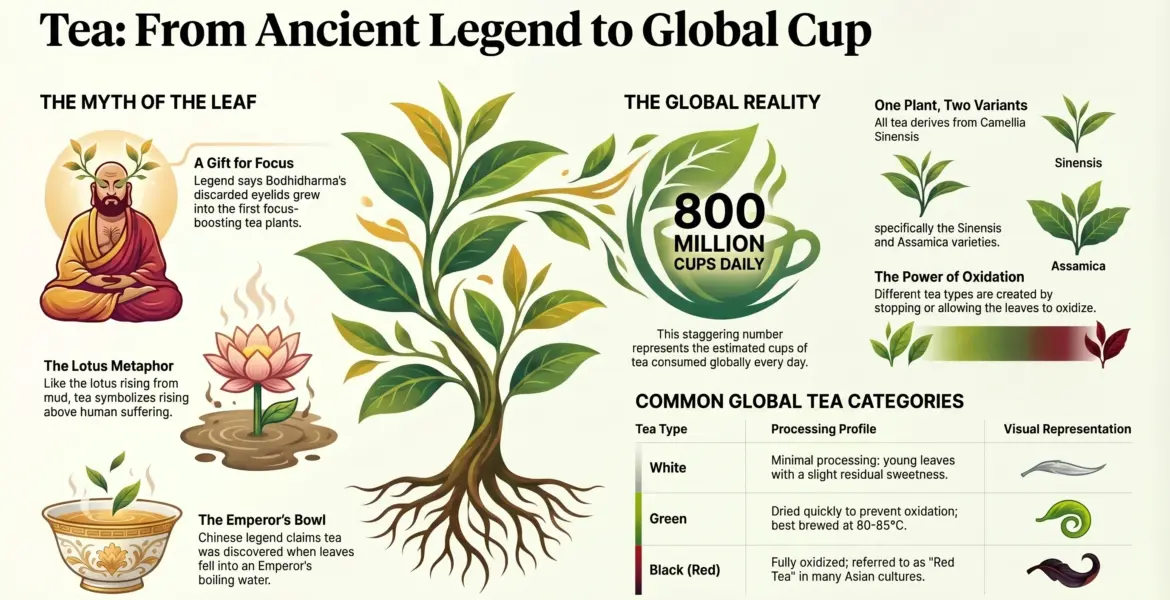
The most prominent Indian legend regarding the discovery of tea centers on Bodhidharma (also known as Bodhi Dharma or Daruma), an ancient Buddhist monk from South India who traveled to China in the 6th century to spread the teachings of Zen Buddhism.
The Legend of Bodhidharma
According to the legend, Bodhidharma committed himself to a rigorous spiritual practice of meditating for nine years without sleep. During this intense retreat, he began to feel tired and drowsy, or in some versions, he actually fell asleep despite his vow. Furious at his own perceived weakness and lack of focus, he took the drastic measure of tearing off his own eyelids and flinging them to the ground to ensure he could never close his eyes again.
Miraculously, in the spot where his discarded eyelids touched the earth, ten tea plants sprouted. Bodhidharma discovered that when the leaves of these plants were put into hot water and drunk, they had the power to banish sleep and enhance alertness, allowing him and his disciples to maintain their concentration during long meditation sessions. This story serves as a religious allegory illustrating the stimulating power of tea and its historical association with focus and spiritual discipline.
The Historical Bodhidharma: Separating Fact from Legend
Before exploring the legend itself, it is worth understanding who Bodhidharma was historically. Bodhidharma (known as Daruma in Japan and Damo in China) was a Buddhist monk who lived during the 5th or 6th century CE. He is traditionally credited with transmitting Chan (Zen) Buddhism to China and is regarded as the first Chinese patriarch of this school.
Historical accounts, including those referenced in Bernard Faure’s scholarly work on Chan Buddhism, describe Bodhidharma as the son of a southern Indian king who attained enlightenment and then traveled to China as a missionary, arriving in Canton around the beginning of the 6th century. His legendary encounter with Emperor Liang Wudi of the Liang dynasty—where Bodhidharma reportedly told the pious emperor that his good works held no merit—demonstrates the monk’s uncompromising approach to spiritual truth.
After this meeting, Bodhidharma is said to have crossed the Yangzi River on a reed and settled at the Shaolin Monastery on Mount Song, where he practiced wall-gazing meditation for nine years. It is within this context of extreme ascetic practice that the legend of tea’s discovery takes root.
The Legend: Eyelids That Became Tea Plants
The core of the Indian legend regarding tea’s discovery unfolds with Bodhidharma deep in meditation. According to multiple sources that record this traditional narrative, Bodhidharma had vowed to meditate for nine years without sleep, determined to achieve enlightenment. He faced a wall in seated meditation, pushing the limits of human endurance.
However, as the story goes, despite his formidable will, human frailty eventually overcame him. After years of practice, exhaustion claimed victory—Bodhidharma fell asleep.
Upon awakening, the legend takes a dramatic turn. Different versions offer slightly different motivations, but the outcome remains consistent. In one telling, Bodhidharma was so overcome with frustration and anger at his own weakness that he acted decisively and violently. In another, equally compelling version, his act was one of penance and self-discipline—a calculated sacrifice to prevent future lapses.
In either case, what Bodhidharma did next is the pivotal moment of the legend: he cut off his eyelids and threw them to the ground.
The act of cutting off one’s eyelids is profoundly symbolic. Eyelids exist to close, to cover the eyes, to facilitate sleep and rest. For a monk dedicated to perpetual awareness and meditation, eyelids represent the very mechanism of unconsciousness. Removing them was the ultimate expression of commitment to wakefulness—a physical manifestation of spiritual vigilance.
What happened next transformed this act of self-mutilation into a gift for humanity. According to the legend, where Bodhidharma’s discarded eyelids touched the earth, a plant miraculously sprouted and grew. This plant, unknown before that moment, was the first tea plant.
Bodhidharma discovered that when the leaves of this plant were brewed in hot water and consumed, they produced a beverage that banished sleep and enhanced mental clarity. The tea leaves, born from his sacrifice, provided exactly what the monk needed—a natural aid to maintain alertness during long hours of meditation, without the dulling effects that might accompany other stimulants.
Some versions of the legend specify that ten tea plants grew from the eyelids, a detail that emphasizes the abundance and generosity inherent in the story—from one act of sacrifice came plentiful sustenance for spiritual practice.
The Deeper Symbolism Within the Legend
To treat this legend as merely a fanciful origin story is to miss its profound symbolic dimensions. The narrative operates on multiple levels, each revealing deeper insights into Indian spiritual traditions and the cultural significance of tea.
Wakefulness as Spiritual Imperative
In Buddhist philosophy, wakefulness is not merely the opposite of sleep—it is a metaphor for enlightenment itself. The Buddha’s very title means “the awakened one.” Sleep, in this context, symbolizes ignorance, delusion, and the tendency of the mind to drift into unconscious patterns of thought and behavior.
Bodhidharma’s extreme act represents the spiritual practitioner’s commitment to awakening at any cost. The tea plant that emerges from this sacrifice becomes the material aid for this spiritual quest—a natural substance that supports the human aspiration toward consciousness and clarity.
Sacrifice and Transformation
The motif of something discarded or sacrificed becoming a source of life and nourishment is a powerful archetype that appears across world mythologies. Bodhidharma’s severed eyelids, something cast away in apparent destruction, become the source of a plant that has sustained and delighted humanity for centuries.
This transformation mirrors the Buddhist understanding of suffering and its transmutation. What appears to be loss—the removal of a body part, the experience of frustration, the confrontation with human limitation—becomes, through proper understanding and right relationship, a source of benefit and awakening.
The Body and the Earth
The legend establishes an intimate connection between the human body and the botanical world. Bodhidharma’s flesh, upon touching the earth, gives rise to a living plant. This reflects the Indian philosophical understanding that human beings are not separate from nature but deeply embedded within it. The tea plant is, in a literal sense, within the legend’s framework, an extension of human consciousness and human striving.
Bodhidharma’s Tea and Indian Cultural Heritage
While the Bodhidharma legend is often cited as the Indian origin of tea, the relationship between India and tea is far richer than a single myth. Understanding how this legend fits within the broader tapestry of Indian tea culture reveals its enduring significance.
Ancient Indian Uses of Tea-Like Beverages
Historical evidence suggests that before the widespread adoption of what we now recognize as tea (Camellia sinensis), ancient Indians consumed herbal concoctions for medicinal purposes. According to research documented by Ashoka University, in ancient India, the word “chai” referred to a healing preparation made from herbs and spices, similar to the traditional kada still consumed today. These early versions did not contain tea leaves and recipes varied according to season and available ingredients.
The Singhpo tribe of Assam, notably, used tea leaves as medicine as far back as the 12th century, indicating an indigenous knowledge of the tea plant long before commercial cultivation began.
The Legend’s Spread and Integration
The Bodhidharma legend travelled alongside Buddhism itself, spreading from India to China, Korea, and Japan. In Japanese Zen tradition, Daruma (Bodhidharma) remains a central figure, and the story of his connection to tea is well known. The legend became particularly significant in Zen monastic practice, where tea drinking was integrated into meditation routines and eventually formalized into ceremonial practices.
In this way, the Indian legend of tea’s discovery became a shared cultural inheritance across East Asia, even as each region developed its own distinctive tea traditions and accompanying mythologies.
The Chinese Counterpart: A Tale of Two Legends
Any discussion of the Indian legend benefits from comparison with its Chinese counterpart. The Chinese legend of tea’s discovery attributes the beverage to Emperor Shen Nong (also spelled Shennong), a mythical ruler and herbalist said to have lived around 2737 BCE.
According to this legend, Shen Nong was in the habit of boiling his drinking water for hygiene. One day, leaves from a nearby wild tea tree drifted into his pot of boiling water. The emperor, known for his scientific curiosity and extensive knowledge of herbs, decided to taste the resulting infusion. He found it delicious and went on to research the plant’s properties, discovering its medicinal benefits.
The contrast between the two legends is illuminating:
| Aspect | Indian Legend (Bodhidharma) | Chinese Legend (Shen Nong) |
|---|---|---|
| Protagonist | A Buddhist monk/ascetic | An emperor/scientist |
| Discovery Method | Miraculous growth from sacrifice | Accidental infusion |
| Core Theme | Spiritual wakefulness | Medicinal and gustatory discovery |
| Emotional Tone | Dramatic, sacrificial | Serene, fortuitous |
| Historical Period | 5th-6th century CE | Circa 2737 BCE (mythical) |
The Indian legend emphasizes tea as a spiritual aid, born of sacrifice and linked to meditation. The Chinese legend presents tea as a gift of nature, discovered through observation and enriched by the pursuit of knowledge. Both narratives capture essential truths about how their respective cultures have valued and integrated tea.
Historical Accuracy and the Function of Myth
Scholarly sources acknowledge that the Bodhidharma legend, while culturally significant, belongs to the realm of mythology rather than documented history. Archaeological evidence suggests that tea leaves steeped in boiling water were consumed far earlier than any of these legends suggest—possibly as far back as 500,000 years ago by Homo erectus pekinensis.
However, questioning whether Bodhidharma literally cut off his eyelids misses the purpose of origin myths. These stories function not as historical records but as cultural artifacts that encode values, explain significance, and provide meaningful frameworks for understanding why certain practices matter.
The Bodhidharma legend communicates several enduring truths:
- Tea and meditation are intimately connected in Indian spiritual tradition
- Wakefulness and clarity are fundamental values associated with tea consumption
- Sacrifice and discipline are woven into the cultural understanding of tea’s origins
- The Indian subcontinent has a legitimate and ancient claim to tea, distinct from Chinese narratives
Alternative Indian Origins: Siddhartha Gautama
While the Bodhidharma legend is the most frequently cited Indian origin story, it is not the only one. One scholarly source mentions a different Indian legend that attributes the introduction of tea to China to Siddhartha Gautama, the historical Buddha himself, during his travels in that country.
This alternative legend, though less commonly referenced, highlights the persistent association between tea and Buddhism in Indian cultural memory. Whether through Bodhidharma or the Buddha directly, the transmission of tea is consistently linked to the spread of Buddhist teachings from India eastward.
The existence of multiple legends does not weaken the cultural authority of any single one; rather, it demonstrates how deeply the association between tea and Indian spiritual tradition has been embedded across different narratives and historical periods.
From Legend to Modern Cup
The Bodhidharma legend continues to resonate because it speaks to experiences that remain relevant for tea drinkers today. When a student brews tea to stay awake while studying, when a meditator sips green tea between meditation sessions, when a worker takes a chai break to refresh the mind—they are participating, knowingly or not, in the ancient connection between tea and wakefulness that the legend encodes.
Modern India’s tea culture, with its masala chai, its roadside tea stalls, its refined Darjeeling and robust Assam varieties, may seem far removed from a monk on a mountainside. Yet the thread of connection persists. The addition of milk and spices to tea, which likely originated with traders and travelers, represents the Indian genius for adaptation—taking the leaf born of ascetic sacrifice and transforming it into a beverage of warmth, hospitality, and daily comfort.
The Ramayana Legend
Another legend traces the roots of tea back to ancient Indian scripts, specifically the Ramayana. In this tale, Lord Rama’s brother, Lakshman, was severely injured during a battle with Ravana. The pupil Hanuman was dispatched to the Himalayas to retrieve the ‘Sanjeevani Booti’, a miraculous healing plant. The leaves were applied to Lakshman’s wounds, leading to a miraculous recovery. Many Sanskrit scholars believe that this legendary ‘Sanjeevani Booti’ was actually tea.
Conclusion
The Indian legend of tea’s discovery—of Bodhidharma’s severed eyelids and the miraculous plant that grew from sacrifice—is more than a quaint tale from antiquity. It is a narrative that speaks to the heart of why tea has remained significant across centuries: its power to awaken, to clarify, and to support human beings in their pursuit of consciousness, whether that pursuit takes the form of formal meditation or simply being present for another day of life.
While historians may point to the British discovery of wild tea in Assam in 1823 as the factual beginning of India’s tea industry, Indians have long understood that their relationship with tea reaches deeper into the past, into the realm where history and mythology converge. The legend of Bodhidharma’s tea affirms an Indian spiritual claim on this global beverage, connecting every cup to themes of discipline, transformation, and the unending human aspiration toward wakefulness.
As you lift your next cup of chai, consider the legend. The warmth you feel, the alertness that follows, and the moment of pause in a busy day all echo the story of a monk who refused to sleep and, in doing so, gave the world a gift that continues to sustain and delight.
References
- Wikipedia, “User:Newwriter007/History of tea in India,” 2024.
- Meritnation, “Write down the Buddhist legend about tea,” 2021.
- Taylor & Francis, “Green Jea,” in Botanical Medicines, 2012.
- Ashoka University, “The Story of Eternal Lovers: India and Chai,” 2024.
- Lyon Collection, “Daruma or Bodhidharma,” woodblockprints.org.
- Haaretz, “Culinary Consumerism: Isn’t it time for a nice cup of tea?,” 2002.
- Ranveer Brar, “All about tea…,” 2015.
- Shaalaa.com, “What Legends Are Associated with the Origin of Tea?,” 2017.
- Peet’s Coffee, “A History of Tea – from Myth to Modern Day,” 2021.
All true tea comes from the same plant. What is it called?
Correct! Whether it’s green, black, oolong, or white — they all come from Camellia sinensis. The differences come from how the leaves are processed.
Not quite! The answer is Camellia sinensis. All true teas originate from this single species of evergreen shrub.
Which type of tea is the most oxidized?
Spot on! Black tea is fully oxidized, which gives it its dark color and robust, malty flavor profile.
Not quite! It’s black tea. Full oxidation transforms the leaves from green to dark brown/black and deepens the flavor.
Matcha is a type of which tea?
Correct! Matcha is finely ground green tea made from shade-grown tea leaves, originating from Japan.
Actually, it’s green tea! Matcha is made from shade-grown green tea leaves that are stone-ground into a fine powder.
What is the ideal water temperature for brewing green tea?
Perfect! Green tea is delicate — water that’s too hot will make it bitter. 70–80°C brings out the sweet, umami notes.
Close, but no! Green tea thrives at 70–80°C. Boiling water scorches the leaves and creates a bitter, astringent cup.
Which country is the largest producer of tea in the world?
Yes! China produces over 40% of the world’s tea, followed closely by India. Tea has been cultivated there for thousands of years.
It’s China! While India is a close second, China leads global tea production by a significant margin.
Earl Grey tea is flavored with which ingredient?
You got it! Bergamot is a citrus fruit from southern Italy. Its fragrant oil gives Earl Grey its signature floral-citrus aroma.
It’s bergamot oil! This citrus-scented essential oil from the bergamot orange is what defines Earl Grey tea.
Oolong tea is partially oxidized. What percentage range does it typically fall in?
Brilliant! Oolong is incredibly diverse — from light and floral (8%) to dark and roasted (80%+). It’s the most varied tea category.
The range is 8–80%! Oolong spans a huge spectrum, which is why no two oolongs taste the same.
What does “chai” actually mean?
Exactly! “Chai” simply means “tea” in Hindi. So “chai tea” is technically redundant — like saying “tea tea”!
It means “tea”! In Hindi, “chai” = tea. What we call “chai” in the West is actually “masala chai” — spiced tea.
Which tea type has the highest caffeine content per cup?
That’s right! Because you consume the whole tea leaf in powdered form, matcha delivers the most caffeine — roughly equivalent to a cup of coffee.
It’s matcha! Since you’re drinking the entire ground leaf (not just an infusion), matcha packs the highest caffeine punch among teas.
Darjeeling tea is often called the “champagne of teas.” Where is it grown?
Well done! Darjeeling is grown in the foothills of the Himalayas in West Bengal, India, at elevations of 1,500–6,000 feet.
It’s India! Darjeeling comes from the Darjeeling district in West Bengal, India, nestled in the Himalayan mountains.