

Welcome to TeaTurbo! If you are holding a warm, comforting mug right now, you might be wondering exactly what is inside it. Whether you rely on a strong cup to wake you up in the morning or prefer a light brew to help you focus, understanding your drink is important. I am Krishna, your resident tea specialist, and I have spent years exploring the rich, vibrant world of tea. Today, we are going to dive into a very common question: what is caffeine in tea, and how does it actually work?
Caffeine is a word we hear every day, usually when people talk about coffee or energy drinks. However, tea has its own unique relationship with this famous energy booster. It does not hit your body the same way a strong espresso does. Instead, it offers a smoother, more balanced experience.
In this guide, we will explore everything you need to know about caffeine in tea. We will keep it simple, easy to understand, and packed with useful tips for your daily brewing routine. Let’s get started!
What Exactly is Caffeine in Tea?
To put it simply, caffeine is a natural stimulant. It is a compound created by certain plants to protect themselves in the wild. For example, when bugs or pests try to eat the leaves of a tea plant, the caffeine acts as a natural bug repellent. It tastes bitter to insects and keeps them away.
- Difference Between Tea and Herbal Tea
- Green Tea With Lemon for Weight Loss
- Black Tea With Lemon for Weight Loss
- Why Your Daily Cup of Tea May Be One of the Simplest Heart-Healthy Habits
- Best Time to Drink Lemon Tea for Weight Loss
For humans, however, caffeine does something completely different. When we drink it, it travels to our brain and blocks a chemical called adenosine. Adenosine is the chemical that makes you feel tired and sleepy. By blocking it, caffeine makes you feel awake, alert, and energized.
Therefore, when you ask, “what is caffeine in tea?” you are really asking about a natural plant defense mechanism that doubles as a gentle brain-booster for humans!
Does All Tea Have Caffeine?
This is where things can get a little confusing. Not all drinks that we call “tea” actually contain caffeine. It all depends on what plant the leaves come from.
True tea comes from a specific plant called Camellia sinensis. If your drink is made from the leaves of this plant, it will naturally contain caffeine. The main types of true tea are black, green, white, oolong, and pu-erh.
On the other hand, we have herbal teas, which are sometimes called “tisanes.” Herbal teas are made by steeping dried flowers, fruits, herbs, or spices in hot water. Because they do not contain leaves from the Camellia sinensis plant, they are naturally caffeine-free. Examples include chamomile, peppermint, and rooibos.
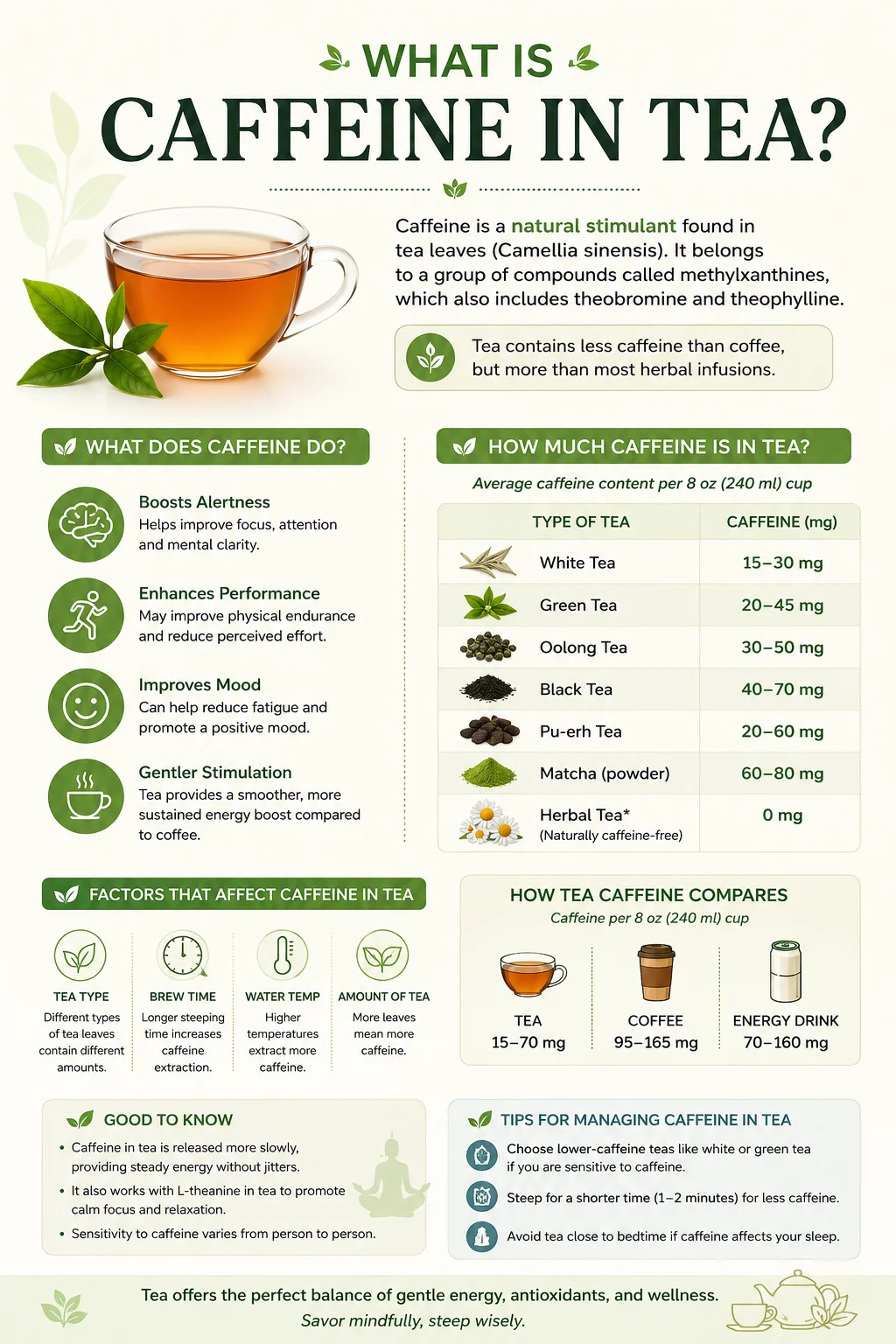
How Much Caffeine is in Tea? (Compared to Coffee)
One of the biggest myths is that tea has just as much caffeine as coffee. While tea leaves actually contain more caffeine than coffee beans in their dry, raw form, we use far fewer tea leaves to brew a cup. Because of this, a brewed cup of tea almost always has less caffeine than a brewed cup of coffee.
For comparison, an average 8-ounce cup of coffee contains about 95 milligrams (mg) of caffeine. Here is how the different types of true tea stack up:
Black Tea
Black tea is fully oxidized, meaning the leaves are exposed to oxygen to turn them dark. This process gives it a bold flavor. An 8-ounce cup usually contains between 40 to 70 mg of caffeine. It is the perfect choice if you want a solid morning boost without the heavy jitters of coffee.
Oolong Tea
Oolong is a traditional Chinese tea that falls somewhere between green and black tea. It is partially oxidized. Because of this, its caffeine levels usually sit right in the middle, offering about 30 to 50 mg per cup.
Green Tea
Green tea is unoxidized, keeping its fresh, grassy color and light flavor. It is famous for its health benefits and gentle energy. A standard cup of green tea contains roughly 20 to 45 mg of caffeine.
White Tea
White tea is the least processed of all true teas. It is made from the youngest, most delicate leaves and buds of the plant. While its caffeine content can vary widely, it generally has the lowest amount, giving you about 15 to 30 mg per cup.
The Magic Ingredient: Why Tea Caffeine Feels Different
Have you ever noticed that a cup of coffee can make you feel hyper, anxious, or shaky, but a cup of tea makes you feel calmly focused? This is not just in your head! It happens because of a special amino acid found only in tea called L-theanine.
L-theanine is nature’s perfect partner for caffeine. While caffeine speeds up your brain, L-theanine promotes relaxation and reduces stress. It slows down the absorption of caffeine into your bloodstream.
As a result, you do not get a sudden spike of energy followed by a harsh crash. Instead, the caffeine in tea gives you a slow, steady, and sustained level of alertness. Monks in ancient times actually drank green tea before meditation for this exact reason—it kept them awake but entirely peaceful.
Factors That Change the Caffeine in Tea
You might buy a box of green tea that says “30 mg of caffeine,” but the actual amount in your mug can change based on how you make it. Here are the three main things that control how much caffeine ends up in your cup:
- Water Temperature: Caffeine extracts faster in boiling hot water. Therefore, if you use rolling boiling water to make black tea, you pull out more caffeine. If you use slightly cooler water for green tea, less caffeine is released.
- Steeping Time: The longer you leave the tea bag or leaves in the hot water, the more caffeine will steep into your drink. A quick 2-minute steep will yield a milder cup than a heavy 5-minute steep.
- Tea Bags vs. Loose Leaf: Tea bags usually contain crushed, broken tea leaves (sometimes called “fannings” or “dust”). Because the leaves are broken into tiny pieces, the water touches more surface area, releasing caffeine very quickly. Whole loose-leaf tea releases its caffeine much slower.
How to Reduce Caffeine in Your Tea
If you love the taste of true tea but are sensitive to caffeine, you do not have to give it up completely. There are a few easy tricks you can use to lower the caffeine in your favorite brew.
First, you can try a quick “rinse.” Steep your tea leaves in hot water for just 30 seconds, pour that water down the drain, and then steep the leaves again in fresh hot water. A large portion of the caffeine washes away in that first quick steep, leaving you with a milder second cup.
Second, you can brew your tea with cooler water and for a shorter amount of time. Lastly, you can simply switch to decaffeinated tea. Decaf tea still comes from the true tea plant, but it goes through a safe washing process that removes about 97% of the caffeine.
The Best Teas for Morning, Noon, and Night
Choosing the right tea at the right time of day can help you manage your energy levels perfectly.
- Morning Power: Reach for a strong Black tea like English Breakfast or Earl Grey. The higher caffeine content will help shake off the sleepiness, while the bold flavor pairs wonderfully with breakfast.
- Afternoon Focus: Green tea or Oolong tea are your best friends here. They provide just enough caffeine to cure the 2:00 PM slump, but they are packed with L-theanine to keep you focused on your work without keeping you up all night.
- Evening Relaxation: Always stick to Herbal teas after dinner. Chamomile, peppermint, and lemon balm contain exactly zero caffeine and will actively help your body wind down for a deep, restful sleep.
Conclusion
Understanding what is caffeine in tea completely changes the way you look at your daily brew. It is not just a simple energy spike; it is a complex, beautifully balanced compound that works together with L-theanine to give you clean, calm focus.
Whether you are enjoying a robust black tea to kickstart your Monday or sipping a delicate white tea on a Sunday afternoon, you are experiencing one of nature’s greatest gifts. You now know exactly how much caffeine is in your cup, why it feels better than coffee jitters, and how to control it with your brewing methods.
So, put the kettle on, pick your favorite flavor, and enjoy your next cup with complete confidence!
Key Takeaways
- Caffeine is natural: It acts as a defense mechanism for the Camellia sinensis plant to ward off insects.
- Not all tea has caffeine: True teas (black, green, white, oolong) have caffeine, while herbal teas (chamomile, peppermint) are naturally caffeine-free.
- Less than coffee: A standard cup of tea generally has half (or even less) the caffeine of a standard cup of coffee.
- Calm energy: Tea contains L-theanine, an amino acid that relaxes the mind and prevents the jittery feeling often associated with coffee.
- You control the brew: Hotter water and longer steeping times pull more caffeine out of the tea leaves.
FAQs
1. Does green tea have caffeine?
Yes, green tea does have caffeine because it comes from the Camellia sinensis plant. However, it generally has less caffeine than black tea, usually around 20 to 45 mg per cup.
2. Why doesn’t tea give me the jitters like coffee?
Tea contains a unique amino acid called L-theanine. This compound slows down how quickly your body absorbs caffeine, resulting in a smooth, steady level of energy without the sudden spikes and crashes of coffee.
3. Which tea has the absolute highest amount of caffeine?
Generally, Matcha (a powdered form of green tea) and certain strong Black teas have the highest caffeine. Because you consume the entire powdered leaf when drinking Matcha, you get a higher dose of caffeine.
4. How can I completely avoid caffeine in tea?
If you want zero caffeine, you should drink herbal teas (tisanes). Teas made from fruits, flowers, and herbs—like rooibos, hibiscus, or peppermint—naturally contain no caffeine at all.
5. Does steeping tea longer increase the caffeine? Yes! The longer you leave the tea bag or leaves in the hot water, the more time the caffeine has to extract into your drink. A 5-minute steep will result in a more caffeinated cup than a 2-minute steep.
