

Tea is much more than just a warm drink in a cup; it is a global phenomenon that has shaped empires, sparked wars, and created beautiful cultures across the world. Today, it is the second most consumed beverage on Earth after water. Whether you enjoy a strong cup of morning chai or a delicate green tea, you are participating in a tradition that is thousands of years old.
Watch: History about tea on Spotify
Understanding the history of tea is important because it tells the story of human connection. It involves ancient kings, brave monks, greedy traders, and even accidental inventions. From its beginnings as a medicine in the high mountains of ancient China to its status as a worldwide lifestyle staple, tea’s journey is truly epic.
1. The Legendary Origins of Tea
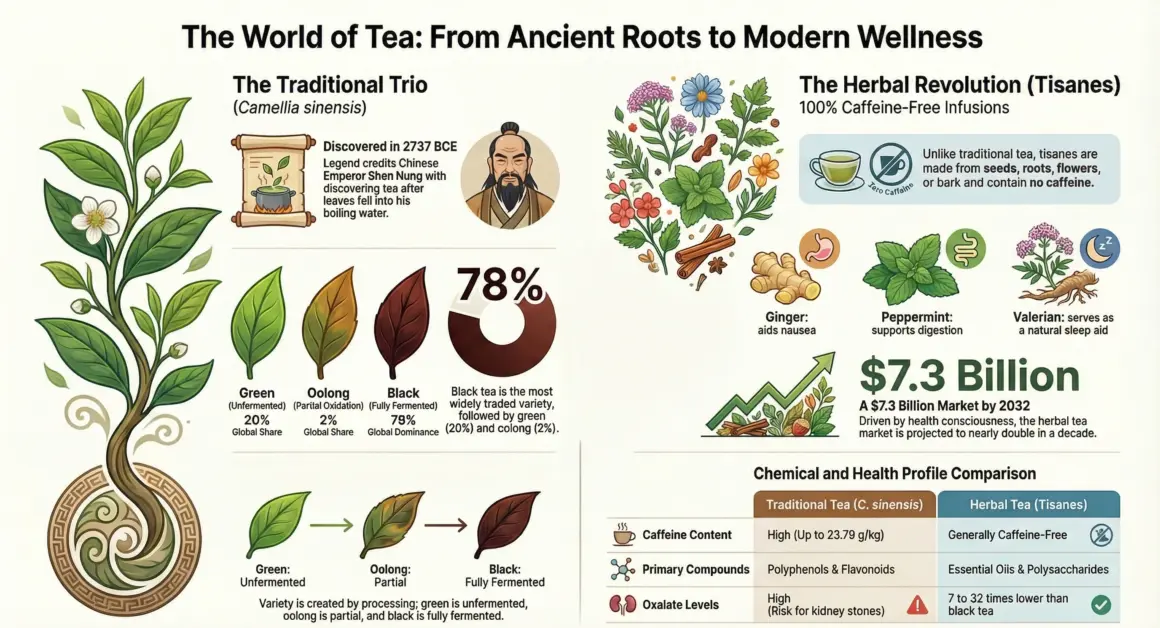
The most famous story about the origin of tea begins in China in 2737 BCE with a legendary ruler named Emperor Shen Nong. As the legend goes, the Emperor was a wise man who believed in boiling water before drinking it for health reasons. One afternoon, while he was resting in his garden with a cup of boiling water, a few leaves from a nearby wild tree blew into his cup.
The water changed color, and the Emperor decided to take a sip. He found the flavor refreshing and noticed that it made him feel more energetic and relieved his discomfort. This “accidental” discovery is widely celebrated as the birth of tea drinking. Another version of the story says he was an expert in herbs who tested plants on himself and used tea as an antidote when he accidentally poisoned himself
In the beginning, tea was not a casual drink. Ancient Chinese civilizations used it primarily as a medicinal herb. It was valued for its ability to detoxify the body and help with digestion. Early forms of tea were very different from what we see today; people often chewed the raw leaves or boiled them into thick, bitter soups and pastes with other herbs
2. Tea in Ancient China
During the Tang Dynasty, tea moved from being a medicine to a popular daily beverage. It was during this time that tea culture really began to flourish. People started holding tea ceremonies, and it became a symbol of status and refinement.
A very important figure from this era was Lu Yu, who wrote the first-ever book dedicated to tea called The Classic of Tea (Cha Jing). This book was like a manual for tea lovers, describing how to grow the plants, how to process the leaves, and the correct way to prepare and evaluate the drink. During this period, tea was often compressed into “bricks” for easy transport, and these bricks were sometimes even used as money.
The Song Dynasty brought new ways to enjoy tea. Instead of boiling leaves in a pot, people began to steam, dry, and grind tea leaves into a fine powder. This powder was then whisked in a bowl with hot water to create a frothy drink—a style that is very similar to modern-day Matcha. This era also saw the rise of artistic tea competitions, where people would compete to see who could make the best-tasting and most beautiful bowl of tea
3. Spread of Tea Beyond China
1 Tea in Japan
Tea traveled to Japan during the 6th century through Buddhist monks who had gone to China to study. Monks like Saichō and Kūkai brought the first seeds back to Japan in the early 800s. Later, in 1191, a Zen priest named Eisai introduced a more refined way of drinking tea and wrote a book titled How to Stay Healthy by Drinking Tea. He believed tea was the “ultimate mental and medical remedy”. This deep connection with Zen Buddhism eventually led to the development of the formal Japanese Tea Ceremony, which is still practiced today as a spiritual ritual.
2 Traveling the Silk Road
As tea became a valuable commodity, it began to spread along the Silk Road trade routes. Caravans of camels carried tea from China to Central Asia and Russia. Because it was easy to transport in brick form and didn’t spoil quickly, it became a highly sought-after item for trade, often exchanged for horses or silk
4. Tea Arrives in Europe
1 First Contact
Europeans first heard about tea from Portuguese and Dutch traders in the 16th and 17th centuries. The Dutch East India Company brought the first shipment of Chinese tea to Europe in 1610. At first, it was an incredibly expensive luxury that only the very wealthy could afford.
2 Tea in Britain
Tea arrived in London coffeehouses in the 1650s, but it became truly famous after Catherine of Braganza, a Portuguese princess, married King Charles II in 1662. She loved tea, and her influence made it the fashionable drink of the British Royal Court. By the mid-1700s, tea had become Britain’s national drink. It also led to the famous tradition of Afternoon Tea, a social ritual where people gathered to eat snacks and drink tea to bridge the long gap between lunch and dinner
5. Colonial Influence and Expansion
1 The British East India Company
To maintain their supply, the British East India Company controlled much of the tea trade, but they were heavily dependent on China. Because the Chinese only wanted silver in exchange for tea, the British looked for ways to grow their own tea within their own colonies.
2 Tea Cultivation in India
In 1824, wild tea plants were discovered growing in the Assam region of India. This was a huge turning point. The British established large plantations in Assam and later in Darjeeling and Nilgiri. By the late 19th century, India had become a major competitor to China in the global tea market.
6. Global Trade Conflicts
1 The Opium Wars
The massive demand for tea led to serious conflicts. Britain’s struggle to pay for tea with silver led them to smuggle opium into China to balance the trade. This resulted in the Opium Wars, which were largely fought over trade imbalances and the control of resources like tea.
2 The Boston Tea Party (1773)
In America, tea became a symbol of rebellion. To protest heavy British taxes on tea, American colonists famously dumped 342 chests of tea into the harbor in an event known as the Boston Tea Party. This act of defiance was a major step toward American independence, and many Americans switched to drinking coffee as a way to show they were no longer loyal to British traditions.
7. Industrialization and Modern Production
1 Mechanization
In the 19th century, tea processing changed from being entirely handmade to using machines. New methods like CTC (Crush, Tear, Curl) allowed for much faster production of black tea, making it cheaper and more accessible to everyone around the world.
2 The Accidental Invention of Tea Bags
One of the most important modern inventions happened by accident. In 1908, a New York tea importer named Thomas Sullivan sent tea samples to customers in small silk bags. Instead of opening the bags, the customers dropped them whole into hot water. They loved the convenience, and the tea bag was born! Later, in 1953, the first instant tea was introduced, making tea even more convenient for our fast-paced lives
8. Understanding the Different Types of Tea
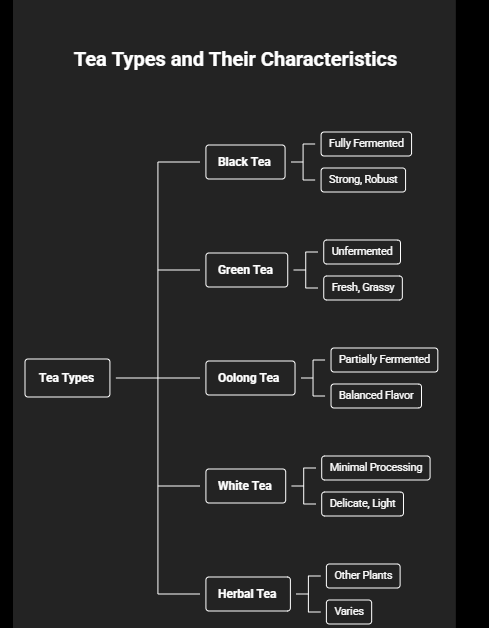
Even though they taste different, almost all traditional teas come from the same plant: Camellia sinensis. The difference lies in how the leaves are processed and how much “fermentation” (oxidation) they undergo.
| Tea Type | Processing Method | Flavor Profile |
|---|---|---|
| Black Tea | Fully fermented (oxidized) | Strong, robust, and dark |
| Green Tea | Unfermented (steamed or pan-fired) | Fresh, grassy, and light |
| Oolong Tea | Partially fermented | Between green and black tea |
| White Tea | Minimal processing (withered and dried) | Very delicate and light |
| Herbal Tea | Made from other plants, not Camellia sinensis | Varies (e.g., mint, ginger) |
9. Cultural and Health Significance
1 Tea Ceremonies
Around the world, tea is a symbol of hospitality.
- China: The Gongfu ceremony focuses on the skill of the brewer.
- Japan: The ceremony is a meditative art form.
- Britain: Afternoon tea is a time for social connection and relaxation.
2 Health and Wellness
Historically used as medicine, modern science confirms that tea is packed with antioxidants and polyphenols. These compounds help protect our cells and may reduce the risk of diseases. Herbal teas are also popular for specific needs: ginger for digestion, chamomile for sleep, and peppermint for headaches
10. Tea in the Modern World
Today, the tea industry is booming. The global herbal tea market alone is expected to reach over $7 billion by 2032. Modern tea lovers are also focusing more on sustainability and ethical sourcing, making sure that the farmers who grow the tea are treated fairly and that the environment is protected
11. Conclusion
Tea’s journey from a legendary leaf falling into an emperor’s cup to a $7 billion industry is a testament to its incredible appeal. It has survived wars, crossed oceans, and adapted to every culture it touched. Whether you prefer it hot, iced, sweet, or plain, every cup of tea contains a little bit of history. So, the next time you take a sip, remember you are part of a story that has been brewing for nearly 5,000 years
Sources: Wikipedia, Tea Research Foundation