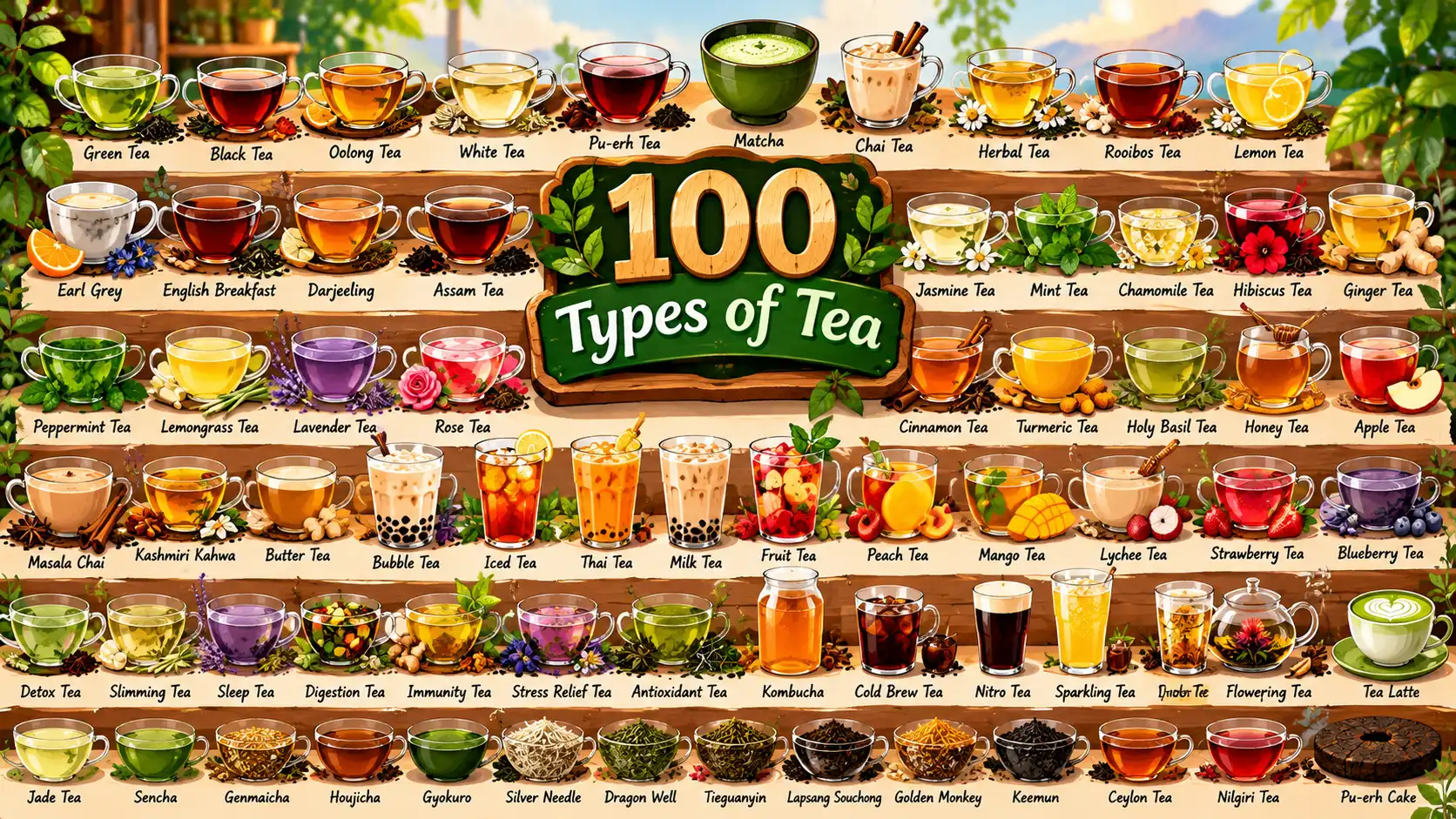
Tea comes in more varieties than most people realize. From the fresh, grassy taste of Japanese green tea to the rich, malty flavor of Indian Assam, every cup offers something different.
But how many types of tea are there?
There are six main categories of traditional tea: green, black, white, oolong, yellow, and dark tea. Within these categories, you’ll find hundreds of regional varieties, processing styles, and blends.
Herbal drinks such as chamomile, peppermint, and hibiscus are also commonly called tea, although they come from different plants.
In this guide, you’ll discover 100 types of tea, their typical flavors, and simple tips to help you choose your next cup.
What Are the Main Types of Tea?
Traditional tea comes from one plant, Camellia sinensis. The differences between tea categories mainly depend on how the leaves are processed, especially oxidation, heating, drying, and fermentation.
Oxidation is a natural chemical process that changes the leaves’ color, aroma, and flavor. Dark teas also involve microbial fermentation.
The international standard ISO 20715:2023 identifies six main tea categories.
| Tea Type | Typical Flavor | Popular Example |
|---|---|---|
| Green | Fresh, grassy, nutty | Sencha |
| Black | Bold, malty, brisk | Assam |
| White | Delicate, subtly sweet | Silver Needle |
| Oolong | Floral, fruity, roasted | Tieguanyin |
| Yellow | Smooth, mellow | Junshan Yinzhen |
| Dark | Earthy, woody | Ripe Pu-erh |
| Herbal infusion | Floral, minty, fruity | Chamomile |
Herbal infusions are included separately because they aren’t made from the traditional tea plant.
100 Types of Tea With Names and Flavors
The following list includes traditional teas, regional specialties, harvest styles, flavored blends, and botanical infusions. These are not 100 separate plant species.
The descriptions represent typical flavor characteristics. Actual taste varies with origin, quality, processing, and brewing.
1. Green Tea Varieties (1–20)
Green tea is heated during processing to limit oxidation. Japanese varieties often have grassy or savory flavors, while Chinese green teas can taste nutty, sweet, or lightly toasted.
- Sencha — Fresh, grassy, slightly sweet.
- Gyokuro — Rich, savory, and full of umami.
- Matcha — Powdered green tea with a creamy, vegetal taste.
- Bancha — Mild, earthy, and refreshing.
- Kukicha — Light, nutty tea made with stems and twigs.
- Hojicha — Roasted green tea with warm, toasty notes.
- Genmaicha — Green tea blended with roasted rice.
- Kabusecha — Smooth, sweet, and pleasantly savory.
- Shincha — Fresh first-harvest tea with a lively flavor.
- Fukamushi Sencha — Deep-steamed tea with a rich, vegetal taste.
- Longjing (Dragon Well) — Smooth, sweet, and chestnut-like.
- Biluochun — Delicate, fruity, and floral.
- Huangshan Maofeng — Gentle, sweet, and lightly floral.
- Taiping Houkui — Fresh, mellow, and orchid-like.
- Lu’an Guapian — Nutty, vegetal, and slightly sweet.
- Xinyang Maojian — Fresh, brisk, and mildly sweet.
- Gunpowder Green — Bold, slightly smoky, and vegetal.
- Anji Bai Cha — Soft, sweet, and rich in umami.
- Chun Mee — Brisk, tangy, and slightly tart.
- Sejak — Korean green tea with fresh, gently nutty notes.
Worth knowing: Despite its name, Anji Bai Cha is a green tea, not white tea. Its name refers to the pale appearance of its young leaves.
2. Black Tea Varieties (21–40)
Black tea undergoes extensive oxidation, producing darker leaves and generally stronger flavors. Some varieties taste excellent with milk, while others are best enjoyed plain.
- Assam — Strong, malty, and full-bodied.
- Darjeeling First Flush — Light, floral, and fresh.
- Darjeeling Second Flush — Fruity, often with muscatel notes.
- Nilgiri — Fragrant, smooth, and brisk.
- Ceylon Uva — Bright, brisk, and aromatic.
- Ceylon Dimbula — Full-bodied and pleasantly refreshing.
- Ceylon Nuwara Eliya — Light, delicate, and floral.
- Keemun — Smooth, subtly smoky, and fruity.
- Dian Hong — Malty, sweet, and honey-like.
- Jin Jun Mei — Sweet, delicate, and aromatic.
- Golden Monkey — Smooth, cocoa-like, and sweet.
- Lapsang Souchong — Traditionally known for its smoky character.
- Yingde Hongcha — Rich, sweet, and malty.
- Nepal Ilam Black — Fragrant, floral, and fruity.
- Kenyan Black — Bold, brisk, and robust.
- Rwandan Black — Bright, rich, and full-bodied.
- Turkish Black Tea — Strong, brisk, and traditionally served plain.
- Earl Grey — Black tea flavored with bergamot.
- English Breakfast — A robust blend, often enjoyed with milk.
- Masala Chai — A spiced tea drink commonly prepared with milk.
Earl Grey and English Breakfast are blends or flavored teas, while masala chai is a prepared beverage rather than a separate processing category.
3. White Tea Varieties (41–46)
White tea is generally made by withering and drying tea leaves with relatively little processing. Its flavors are often delicate, sweet, and floral.
- Silver Needle (Baihao Yinzhen) — Delicate, sweet, and floral.
- White Peony (Bai Mudan) — Mild, fruity, and honey-like.
- Gong Mei — Richer, with gentle herbal sweetness.
- Shou Mei — Mellow, fruity, and sometimes woody.
- Moonlight White — Smooth, sweet, and lightly fruity.
- Darjeeling White — Delicate, fragrant, and floral.
4. Oolong Tea Varieties (47–62)
Oolong sits between green and black tea in terms of oxidation. Lightly oxidized styles often taste floral, while darker or roasted versions develop deeper, toasted flavors.
- Tieguanyin (Iron Goddess) — Floral, creamy, and smooth.
- Da Hong Pao — Roasted, mineral-rich, and complex.
- Shui Xian — Woody, roasted, and aromatic.
- Rou Gui — Warm, spicy, and mineral-rich.
- Bai Ji Guan — Delicate, sweet, and lightly fruity.
- Tie Luo Han — Rich, roasted, and earthy.
- Shui Jin Gui — Floral, fruity, and mineral-like.
- Dong Ding — Toasty, creamy, and sweet.
- Oriental Beauty — Honey-like, fruity, and floral.
- Alishan Oolong — Smooth, floral, and creamy.
- Lishan Oolong — Fragrant, sweet, and refreshing.
- Shan Lin Xi Oolong — Fresh, floral, and gently sweet.
- Baozhong — Light, floral, and delicate.
- Jin Xuan (Milk Oolong) — Naturally creamy and buttery.
- Mi Lan Xiang Dan Cong — Fragrant, floral, and honey-like.
- Ya Shi Xiang Dan Cong — Highly aromatic, floral, and fruity.
5. Yellow Tea Varieties (63–67)
Yellow tea is a less common category produced using a special yellowing process that softens some of the sharper characteristics associated with green tea.
- Junshan Yinzhen — Smooth, mellow, and sweet.
- Mengding Huangya — Gentle, nutty, and floral.
- Huoshan Huangya — Sweet, fresh, and lightly nutty.
- Mogan Huangya — Mellow, smooth, and subtly sweet.
- Beigang Maojian — Soft, fragrant, and gently toasted.
6. Pu-erh and Other Dark Teas (68–75)
Dark teas develop distinctive flavors through microbial fermentation and, in some cases, aging.
Pu-erh from China’s Yunnan region is especially well known. Raw and ripe pu-erh follow different processing methods.
- Sheng Pu-erh (Raw) — Fresh and sometimes bitter when young; more complex with age.
- Shou Pu-erh (Ripe) — Smooth, earthy, and woody.
- Liu Bao — Mellow, woody, and earthy.
- Fu Zhuan — Smooth, earthy, and gently sweet.
- Qian Liang — Rich, aged, and woody.
- Tian Jian — Robust, smoky, and earthy.
- Qing Zhuan — Deep, mellow, and earthy.
- Kang Zhuan — Strong, woody, and full-bodied.
7. Herbal and Other Botanical Infusions (76–100)
Herbal infusions are made from flowers, roots, seeds, herbs, or leaves of plants other than Camellia sinensis.
Most single-herb infusions below are naturally caffeine-free, but yerba mate, guayusa, and yaupon naturally contain caffeine.
- Chamomile — Gentle, floral, and apple-like.
- Peppermint — Cool, minty, and refreshing.
- Spearmint — Sweet, mild, and minty.
- Ginger — Warm, spicy, and slightly sweet.
- Turmeric — Earthy, warm, and mildly bitter.
- Hibiscus — Tart, fruity, and cranberry-like.
- Rooibos — Smooth, earthy, and naturally sweet.
- Honeybush — Sweet, honey-like, and floral.
- Tulsi (Holy Basil) — Herbal, peppery, and aromatic.
- Lemon Balm — Gentle, herbal, and lemony.
- Lemongrass — Bright, citrusy, and refreshing.
- Rosehip — Tart, fruity, and tangy.
- Lavender — Fragrant, floral, and slightly sweet.
- Rose Petal — Delicate, floral, and aromatic.
- Chrysanthemum — Floral, mild, and slightly herbal.
- Butterfly Pea Flower — Mild, earthy, with a vivid blue color.
- Fennel — Sweet, aromatic, and licorice-like.
- Nettle — Grassy, earthy, and vegetal.
- Dandelion Root — Earthy, with roasted notes when toasted.
- Chicory Root — Roasted, nutty, and coffee-like.
- Lemon Verbena — Fresh, citrusy, and fragrant.
- Licorice Root — Naturally sweet, with a distinctive herbal flavor.
- Yerba Mate — Grassy, earthy, and naturally caffeinated.
- Guayusa — Smooth, herbal, and naturally caffeinated.
- Yaupon — Mildly earthy, sometimes roasted, and naturally caffeinated.
How to Choose the Right Tea
With 100 options available, choosing your first tea doesn’t have to be difficult. Start with your preferred flavor and caffeine needs.
Choose by Flavor
- Fresh and grassy: Try Sencha or Longjing.
- Strong and bold: Choose Assam or English Breakfast.
- Light and floral: Explore Silver Needle or Baozhong.
- Sweet and roasted: Try Hojicha or Dong Ding.
- Earthy and mellow: Consider ripe Pu-erh or rooibos.
- Fruity and tart: Hibiscus is a good starting point.
If you’re new to tea, purchase small quantities of a few different varieties before committing to larger packages.
Choose by Caffeine Preference
Traditional teas naturally contain caffeine. However, the amount in your cup depends on the leaves, serving size, and brewing method.
Green tea isn’t automatically lower in caffeine than black tea, and white tea isn’t necessarily low-caffeine.
For a naturally caffeine-free option, consider pure chamomile, peppermint, rooibos, or hibiscus.
Remember that yerba mate, guayusa, and yaupon are botanical drinks that contain caffeine, as documented in research on caffeinated Ilex plants.
Simple Tea Brewing Tips
Brewing temperature and steeping time can make a noticeable difference in flavor.
As a starting point:
| Tea Type | Water Temperature | Steeping Time |
|---|---|---|
| Green | 75–85°C | 1–3 minutes |
| Black | 90–98°C | 3–5 minutes |
| White | 75–90°C | 2–5 minutes |
| Oolong | 85–95°C | 2–4 minutes |
| Yellow | 75–85°C | 2–3 minutes |
| Dark | 90–100°C | 2–5 minutes |
These are general guidelines. Follow the instructions on your tea package, particularly for specialty teas.
The UK Tea & Infusions Association recommends approximately 80°C for green tea and 90–98°C for black tea.
Frequently Asked Questions
What are the six main types of tea?
The six traditional categories are green, black, white, oolong, yellow, and dark tea. They come from the same tea plant but differ in processing.
Which types of tea contain caffeine?
All six traditional tea categories naturally contain caffeine. The amount varies by product and preparation. According to the FDA, even decaffeinated tea may retain some caffeine.
Is herbal tea considered real tea?
Botanically, no. Herbal infusions come from plants other than Camellia sinensis, although they’re commonly called herbal teas.
Which tea is best for beginners?
Sencha is worth trying for a fresh flavor, Assam for a strong cup with milk, and rooibos for a naturally caffeine-free option. Choose according to your taste rather than assuming one tea is best for everyone.
Final Thoughts
Exploring different types of tea is an enjoyable way to discover new flavors and traditions.
Begin with one green tea, one black tea, one oolong, and one herbal infusion. Compare their aromas, tastes, and brewing methods.
You don’t need to try all 100 varieties at once. A few carefully chosen cups are enough to begin discovering which teas you enjoy most.
