
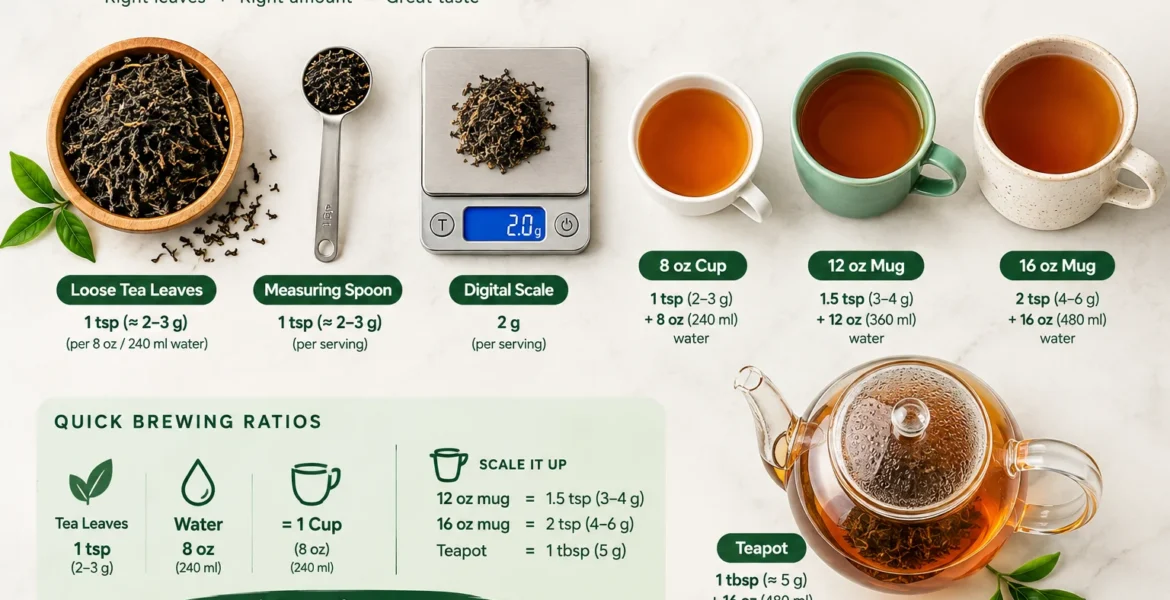
A practical tea to water ratio for Western-style brewing is about 2.5 grams of loose leaf tea per 8 fl oz (240 ml) of water. For many medium-density teas, that is roughly one rounded measuring teaspoon.
Twinings gives one teaspoon per 8 ounces as a beginner-friendly rule of thumb, while specific Harney & Sons loose teas use about 2.5 grams per 8-ounce cup. Treat this as a starting point rather than a fixed rule because loose tea leaves vary greatly in size and density.
Tea-to-Water Ratio Chart
Use this chart for ordinary Western-style brewing.
| Cup, Mug or Pot | Water | Loose Tea | Approx. Teaspoons* |
| Small teacup | 6 fl oz (180 ml) | 1.9 g | ¾ tsp |
| Standard U.S. cup | 8 fl oz (240 ml) | 2.5 g | 1 tsp |
| Small mug | 10 fl oz (300 ml) | 3.1 g | 1¼ tsp |
| Regular mug | 12 fl oz (355 ml) | 3.7 g | 1½ tsp |
| Large mug | 16 fl oz (475 ml) | 5 g | 2 tsp |
| Travel mug | 20 fl oz (590 ml) | 6.2 g | 2½ tsp |
| 3-cup pot | 24 fl oz (710 ml) | 7.5 g | 3 tsp |
| 4-cup pot | 32 fl oz (950 ml) | 10 g | 4 tsp |
| 5-cup pot | 40 fl oz (1.18 L) | 12.5 g | 5 tsp |
| 6-cup pot | 48 fl oz (1.42 L) | 15 g | 6 tsp |
| 8-cup pot | 64 fl oz (1.9 L) | 20 g | 8 tsp |
*Teaspoons are approximate. Large, fluffy leaves can fill much more spoon space than dense rolled or broken tea.
Chec: Tea brewing calculator
What Does “One Cup” of Tea Mean?
This is where tea measurements often become confusing.
A U.S. measuring cup is 8 fluid ounces, approximately 237 ml. For everyday kitchen use, this is commonly rounded to 240 ml.
Your drinking cup may not actually hold 8 ounces.
A mug could hold:
- 10 fl oz
- 12 fl oz
- 16 fl oz
- 20 fl oz or more
A teapot described as a “4-cup pot” can also use a different definition of cup.
For accurate tea measurements, check the vessel’s capacity in fluid ounces or milliliters instead of relying only on the word “cup.”
Grams or Teaspoons: Which Is Better?
Grams are more accurate.
A teaspoon measures volume, while grams measure the actual mass of tea.
One teaspoon of finely broken black tea can contain considerably more tea than one teaspoon of large white-tea leaves. Twinings similarly notes that fluffy botanicals such as chamomile occupy more space than denser teas such as black tea.
For everyday brewing, teaspoons are convenient.
For consistent results, use a small digital scale and start with:
2.5 g tea : 8 fl oz water
That is approximately a 1:96 tea-to-water ratio by weight.
How to Calculate Tea for Any Mug or Teapot
You do not need a separate chart for every vessel.
Use:
Tea needed = water volume ÷ 8 × 2.5 g
For a 12-ounce mug:
12 ÷ 8 × 2.5 = 3.75 g
Use about 3.7–3.8 grams of loose tea.
For a 32-ounce teapot:
32 ÷ 8 × 2.5 = 10 g
Use about 10 grams.
If you measure water in milliliters, use:
Water in ml ÷ 240 × 2.5 g
How to Make the Tea Stronger or Weaker
The chart gives you a balanced starting point. Your preferred ratio may be slightly different.
For a lighter cup, try about 2 grams per 8 fl oz.
For a balanced cup, start around 2.5 grams per 8 fl oz.
For a stronger cup, try about 3 grams per 8 fl oz.
If your tea tastes weak, increasing the amount of tea is often more useful than simply leaving the leaves in the water for much longer. Longer steeping can also increase bitter or astringent flavors.
Change only one variable at a time so you can tell what improved the cup.
Why One Teaspoon Does Not Work for Every Tea
“Use one teaspoon per cup” is convenient, but it is only an estimate.
Loose teas can look very different:
Dense teas: Broken black tea and tightly rolled oolong can pack substantial weight into a small spoon.
Large leaves: Whole-leaf green, white, and twisted oolong teas occupy more space.
Fluffy ingredients: Chamomile flowers and some herbal blends can require substantially more spoon volume for the same weight.
That is why a gram measurement transfers more reliably from one tea to another.
If the package provides specific brewing instructions, follow those first.
What About Tea Bags?
Do not automatically apply the loose-leaf teaspoon chart to tea bags.
Tea bags already contain a measured quantity of tea, and the amount varies by manufacturer and product. Use the water quantity stated on the package whenever available.
If a tea bag tastes weak in a very large mug, the problem may simply be that the bag was designed for a smaller serving.
When This Tea Ratio Chart Does Not Apply
This chart is primarily for Western-style loose leaf brewing, where a modest amount of tea steeps in a cup or pot for several minutes.
Different ratios are used for methods such as:
- gongfu brewing
- matcha
- concentrated iced-tea brewing
- cold-brew recipes
- specialty Japanese green-tea preparation
For those methods, use the brewing directions designed specifically for the tea and preparation style.
The Simple Ratio to Remember
If you want one number to remember, use:
2.5 grams of loose leaf tea for every 8 fl oz (240 ml) of water.
That means:
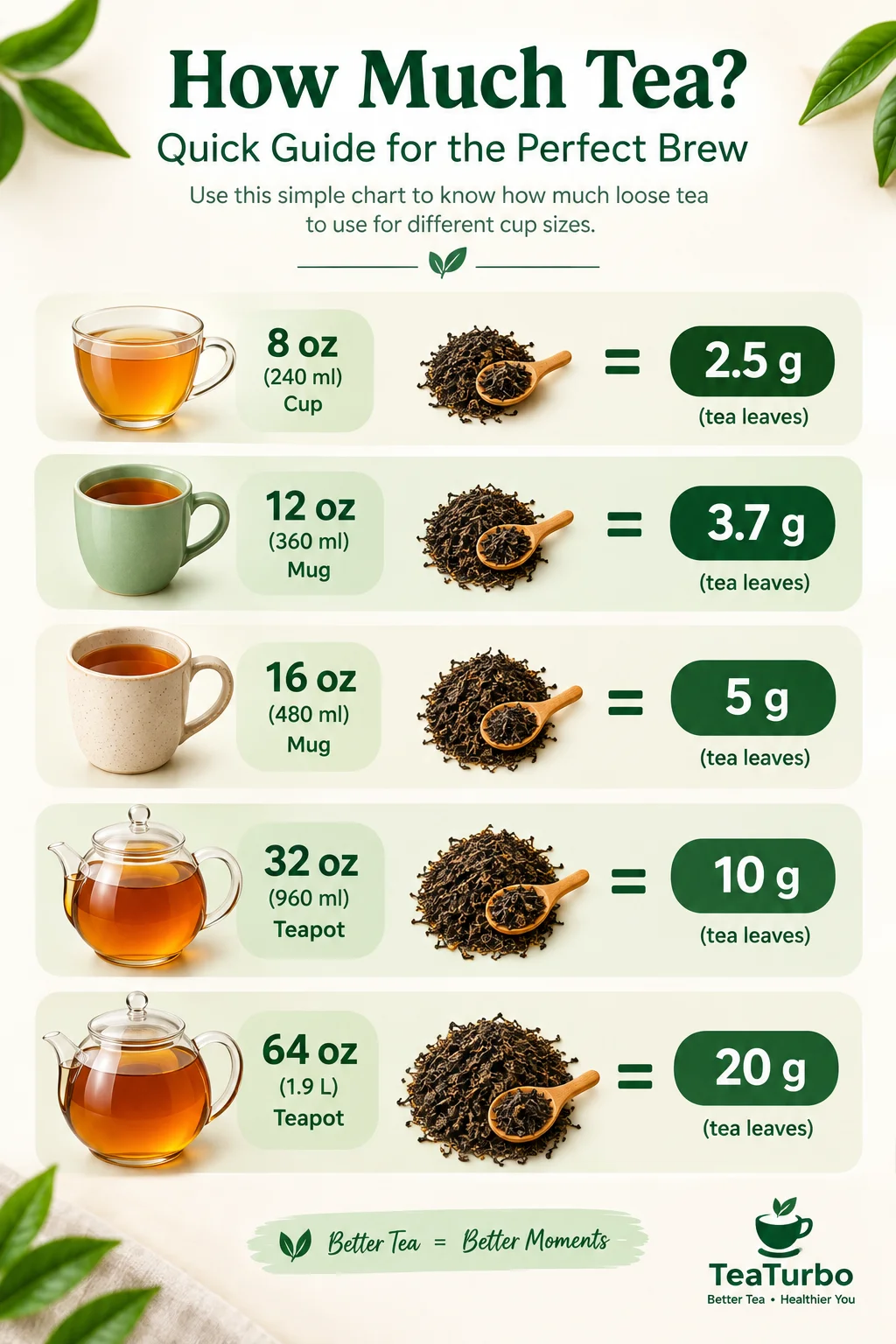
8 oz = 2.5 g
12 oz = 3.7 g
16 oz = 5 g
32 oz pot = 10 g
Measure the actual amount of water your mug or teapot holds, then scale the tea proportionally.
For the most consistent results, measure loose tea by weight rather than assuming every teaspoon of leaves weighs the same.
4. FAQ
What is the standard tea-to-water ratio?
For ordinary Western-style loose leaf brewing, 2–3 grams per 8 fl oz (240 ml) is a practical range. TeaTurbo’s balanced starting point is 2.5 grams per 8 ounces.
How much loose leaf tea should I use for a 12 oz mug?
Use about 3.7 grams, or roughly 1½ teaspoons for a medium-density loose tea.
How much tea should I use for a 16 oz mug?
Start with approximately 5 grams, or about 2 teaspoons for many medium-density teas.
How much tea should I put in a 32 oz teapot?
Use approximately 10 grams of loose tea for a balanced Western-style brew.
Is one teaspoon of loose leaf tea enough for one cup?
Often, yes, if the cup contains about 8 fl oz and the tea has an average leaf density. Large or fluffy leaves can require more spoon volume, so weighing the tea is more reliable.
Should I add more tea or steep longer for stronger tea?
Try slightly more tea first. Excessively extending the steeping time can increase bitterness and astringency along with strength.
AUTHORITATIVE SOURCES
| Organization / Publication | Source Topic | Why It Is Authoritative |
| National Institute of Standards and Technology (NIST) | U.S. cups, fluid ounces, teaspoons, and metric conversions | U.S. federal standards and measurement authority. NIST lists one U.S. cup as 8 fl oz, approximately 237 ml, with 240 ml used as a practical kitchen equivalent. |
| Twinings North America | Loose leaf tea measurement and brewing | Primary brewing guidance from an established tea manufacturer. Its loose-tea guide recommends roughly one teaspoon for every 8 ounces of water and explains that tea density affects spoon measurements. |
| Harney & Sons Fine Teas | Manufacturer tea preparation quantities | Primary product and brewing documentation. Several loose teas specify approximately one teaspoon or 2.5 grams per 8-ounce serving, providing useful confirmation for the article’s practical baseline. |
| ISO | Standardized preparation of tea for sensory testing | ISO publishes the current ISO 3103:2019 standard for preparing tea liquor for sensory testing. It is useful for understanding standardized tea evaluation, although it should not be presented as the required home-brewing ratio. |
