
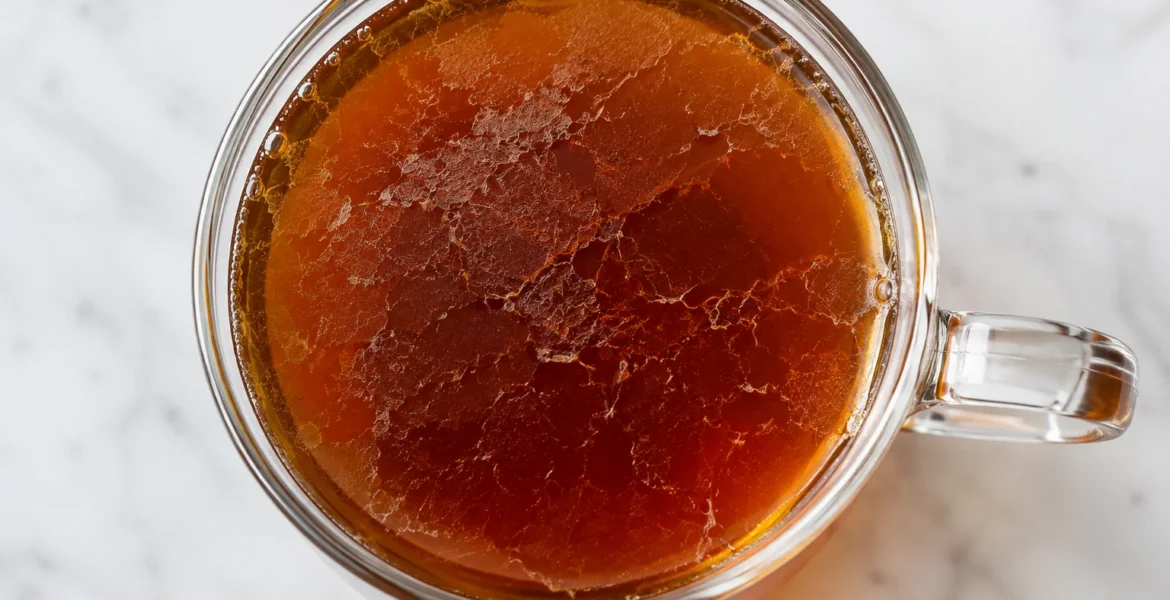
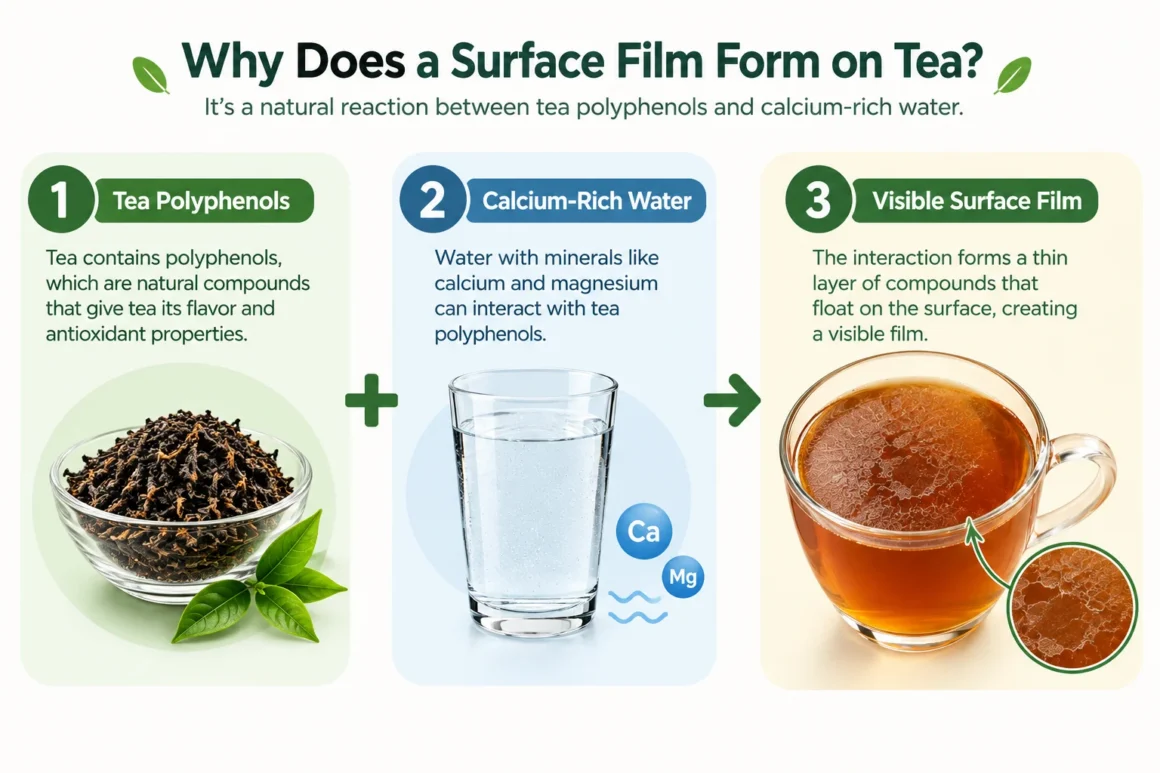
If you see a thin, shiny, gray-brown, or slightly iridescent tea film on top, the usual cause is tea scum. It forms when compounds in tea, especially polyphenols, interact with minerals in the brewing water. Calcium is particularly important, which is why the film tends to become more noticeable with harder water.
It may look oily and can sometimes crack into patches when the tea is stirred. On freshly brewed plain tea, however, this appearance usually comes from water chemistry rather than oil floating off the tea leaves.
| What You Notice | Most Likely Explanation | What to Try |
| Thin shiny film | Tea compounds reacting with water minerals | Try lower-hardness water |
| Film that cracks when disturbed | Typical tea surface film or tea scum | Filter or change the brewing water |
| More film with your tap water | Water may contain more calcium and magnesium | Compare tap and filtered water |
| Actual oil droplets in flavored tea | Flavoring, citrus, herbs, or spices may contain oils | Check the tea ingredients |
| Film in tea containing milk | Milk proteins and fat can also affect the surface | Compare the tea without milk |
What Is the Film on Tea?
Tea scum is more complicated than simply having pieces of limescale floating in your cup.
Research describes tea film as a surface layer containing tea polyphenols complexed with ions from the water. Calcium plays an especially important role. Earlier chemical studies also identified calcium carbonate within tea scum, but research indicates that calcium and bicarbonate ions participating in the reaction are more important than simply having loose calcium carbonate particles in the drink.
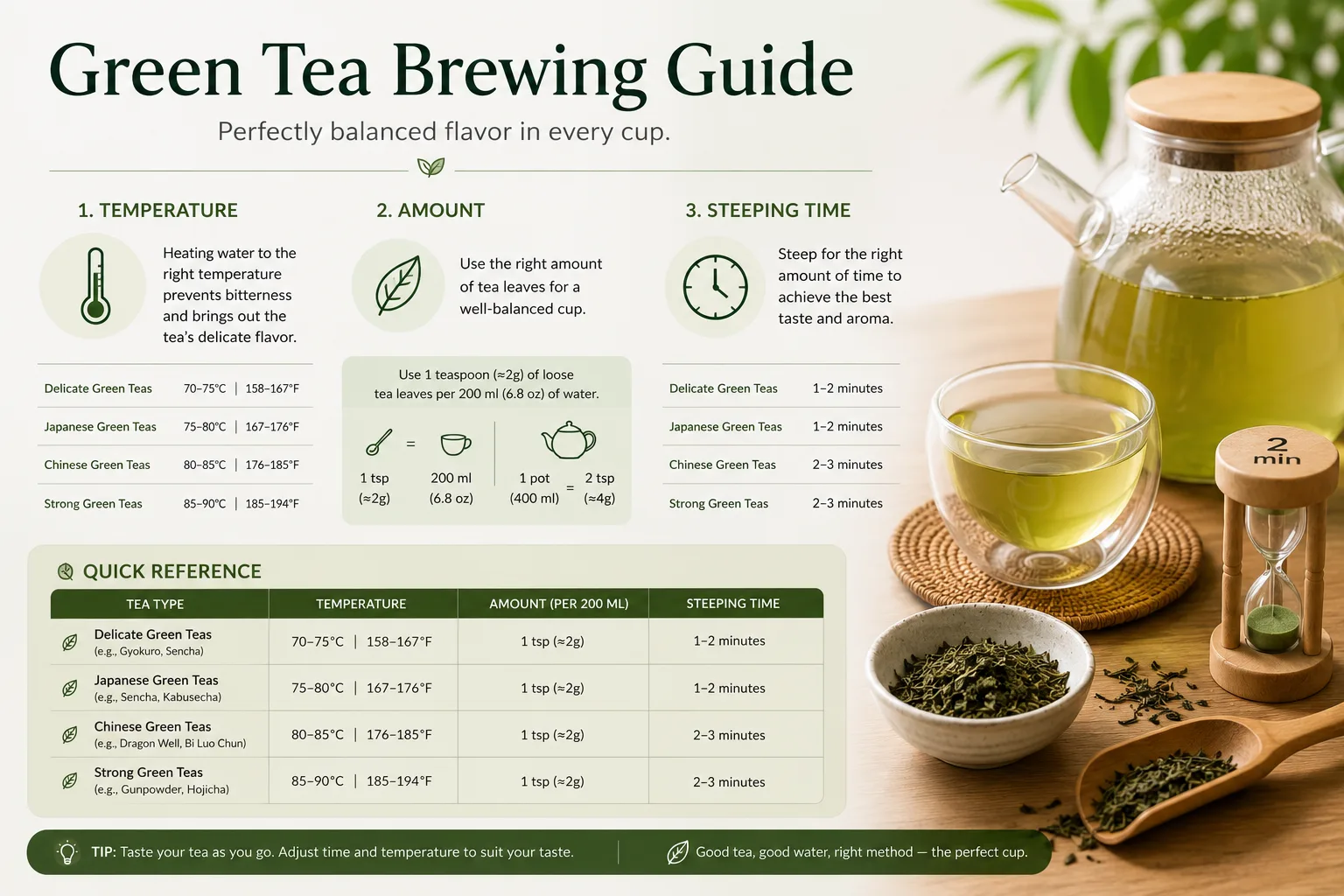
Also Read: Tea brewing guide
This distinction matters because the film is sometimes incorrectly described as nothing more than calcium carbonate.
It is also not necessarily wax coming from the tea leaves. Research investigating tea scum specifically rejected an earlier explanation that the film was mainly leaf-surface wax released during brewing.
Why Hard Water Causes More Tea Film
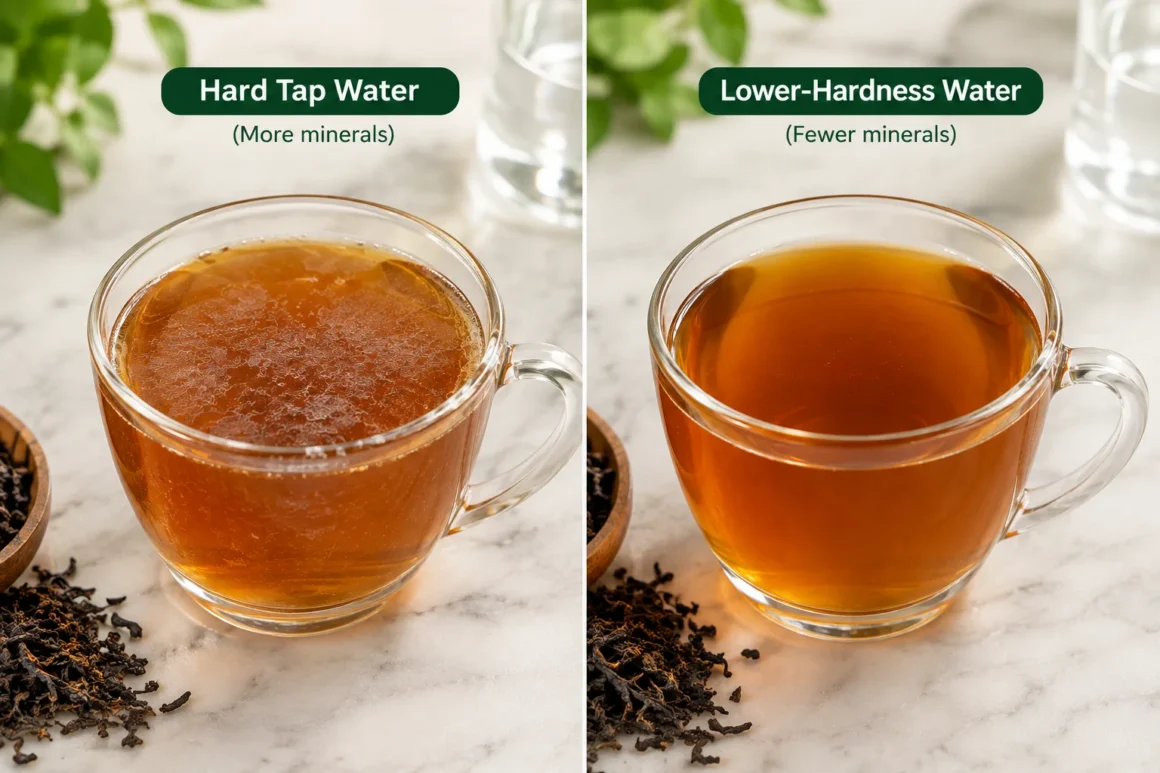
Hard water contains relatively high concentrations of dissolved minerals, especially calcium and magnesium. The U.S. Geological Survey defines water hardness primarily by the amount of these minerals in the water.
When tea is brewed, its polyphenols enter the water. Calcium and other ions can interact with these compounds and help create a film at the air-tea surface.
A 2023 study published in Soft Matter found that water hardness was a major influence on tea-film strength. Increasing hardness, and particularly increased calcium concentration, produced stronger surface films. Both black tea and green tea were capable of developing these films.

So if the same tea suddenly starts developing a film after you move, change water sources, or brew somewhere else, the water is one of the first things worth checking.
Is Tea Film Safe to Drink?
A normal mineral-related film appearing on freshly brewed tea made with drinkable water is generally a water-quality and appearance issue rather than evidence that the tea is contaminated.
The minerals responsible for water hardness are mainly calcium and magnesium. The USGS notes that the EPA does not set a legal drinking-water limit specifically for hardness because the principal hardness-producing ions are not considered toxic.
That does not mean every unknown layer on an old drink should automatically be called tea scum. A normal tea film forms during or shortly after brewing and often looks shiny or cracked. Visible mold, an unusual smell, or changes appearing after tea has been left improperly stored are a different issue.
How to Stop a Film From Forming on Tea
The simplest test is to brew the same tea with lower-hardness water.
If the film becomes much weaker or disappears, your water was probably the main factor.
Useful options include:
- Try appropriately filtered water. Choose a filtration method designed to reduce hardness or mineral content if hardness is the problem. A basic carbon filter does not necessarily remove significant amounts of calcium and magnesium.
- Compare with a lower-mineral bottled water. You do not need completely mineral-free water. The goal is simply to determine whether your usual water is causing the film.
- Add lemon if it suits the tea. Research found that fresh lemon juice substantially reduced tea-scum formation in hard water. The researchers attributed this partly to lower pH and the interaction of citric acid with calcium ions.
- Keep the kettle free of scale. Descaling removes mineral deposits already attached to the kettle. However, it does not make incoming hard tap water soft. If the water itself remains hard, tea film can still develop.
That last distinction is useful: cleaning your kettle is good maintenance, but changing the brewing water is the more direct experiment for tea scum.
Read more: Best water temperature for tea
Why Does the Film Look Oily?
The shiny appearance can make tea scum look like oil even when oil is not responsible.
Surface films reflect light differently from the liquid underneath, producing a shiny or sometimes rainbow-like appearance. The layer may also split into small sections when the cup is moved.
There is one important exception. Flavored teas containing ingredients such as bergamot, citrus peel, spices, or added flavor oils can genuinely contain small amounts of oil. In those cases, visible droplets may come from the ingredients rather than hard-water tea scum.
For plain black or green tea, however, a thin cracking film that changes when you switch water is much more consistent with tea-film chemistry.
Does the Type of Tea Matter?
Yes, but water hardness remains one of the strongest variables.
The 2023 study found differences between green and black tea in the appearance and mechanical strength of their surface films. Green tea produced particularly visible layers under some tested water conditions, while black and green tea behaved differently as hardness changed.
That means there is no useful rule that says only black tea develops tea scum.
Your results can vary with:
- tea type
- concentration
- polyphenol composition
- water hardness
- calcium concentration
- additives such as lemon or milk
Milk complicates the situation further. Research on black tea brewed in hard water found that milk changed the composition and amount of material forming at the surface, so milk should not be treated as a universal solution for tea film.
Read more: Tea steeping time
A tea film on top is usually tea scum formed by interactions between tea polyphenols and minerals in the brewing water, particularly calcium. Hard water makes the effect more likely and can produce a stronger surface film.
The easiest way to confirm the cause is simple: brew the same tea once with your normal tap water and once with lower-hardness water.
If the second cup stays noticeably clearer, you have probably found the cause.
4. FAQ
Why does my tea have an oily-looking film on top?
A shiny film can be tea scum rather than oil. Tea polyphenols can interact with calcium and other ions in brewing water to form a thin surface layer.
Does hard water cause tea scum?
Yes. Research shows that increasing water hardness strengthens tea films, with calcium playing an important role.
Will filtered water prevent the film?
It can if the filtration system meaningfully reduces the minerals responsible for hardness. Not every drinking-water filter removes calcium and magnesium, so check what the filter is designed to reduce.
Can lemon get rid of tea scum?
Lemon can substantially reduce it. Research found that lemon juice reduced tea-scum formation through its acidity and interaction with calcium ions.
Does descaling my kettle stop tea film?
Not necessarily. Descaling removes deposits already inside the kettle. It does not remove the dissolved calcium and magnesium from fresh hard water.
AUTHORITATIVE SOURCES
- Royal Society of Chemistry — Soft Matter, 2023
Source topic: Tea film formation under different water-hardness conditions.
Why authoritative: Peer-reviewed experimental research examining water composition, calcium, tea types, film strength, and structure. This should be the article’s primary scientific source. - U.S. Geological Survey — Water Science School
Source topic: Water hardness, calcium, magnesium, and U.S. hardness classifications.
Why authoritative: U.S. federal scientific agency and appropriate primary reference for a U.S.-focused explanation of water hardness. - Spiro, Chong & Jaganyi — Food Chemistry, 1996
Source topic: Effects of calcium/bicarbonate, lemon juice, and sugar on tea scum.
Why authoritative: Peer-reviewed experimental study directly investigating tea-scum chemistry and showing that lemon can reduce formation. - Spiro & Jaganyi — Food Chemistry, 1994
Source topic: Chemical composition and structure of tea scum.
Why authoritative: Laboratory analysis of collected tea-film material using several analytical techniques. - Spiro & Chong — Food Chemistry, 1997
Source topic: Tea surface films when milk is added to black tea brewed with hard water.
Why authoritative: Peer-reviewed experimental research useful for explaining why milk tea is chemically different from plain tea.
