
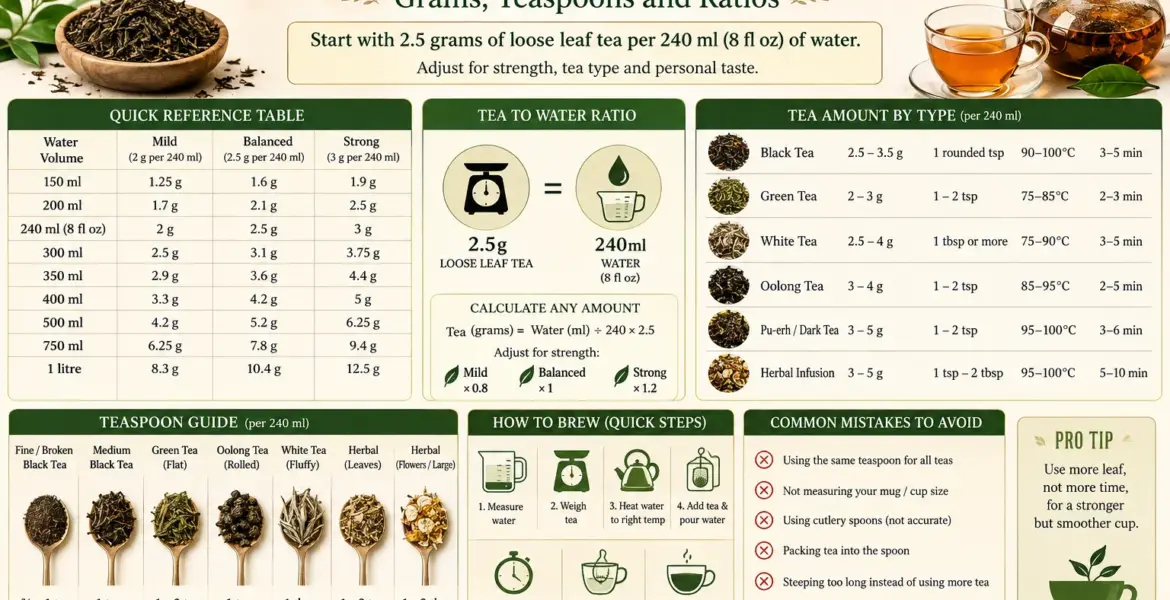
For most Western-style brewing, use 2–3 grams of loose leaf tea per 8 US fluid ounces, or approximately 240 millilitres, of water. A practical starting point is 2.5 grams per cup, which is approximately one rounded measuring teaspoon for many medium-density teas.
However, teaspoons are less reliable than grams. Large, fluffy white teas may require a tablespoon or more to reach the same weight as one teaspoon of a dense rolled oolong or finely broken black tea. Industry recommendations commonly range from 2 to 3 grams per 8-ounce cup, while the UK Tea & Infusions Association recommends one rounded teaspoon per cup.
Quick answer
Use this starting ratio:
2.5 grams of loose leaf tea for every 240 millilitres or 8 fluid ounces of water.
Adjust it as follows:
- Use 2 grams for a lighter cup.
- Use 2.5 grams for a balanced cup.
- Use 3 grams for a stronger cup.
- Use more leaf rather than greatly extending the steeping time when you want stronger tea.
A US customary cup is approximately 236.6 millilitres and is normally rounded to 240 millilitres for kitchen measurements. Your actual drinking mug may hold considerably more than one measuring cup, so measuring the mug’s capacity produces a more accurate result.
Loose leaf tea quick-reference table
The following table uses a range of 2–3 grams per 240 millilitres.
| Water volume | Mild tea | Balanced tea | Strong tea |
|---|---|---|---|
| 150 ml | 1.25 g | 1.6 g | 1.9 g |
| 180 ml | 1.5 g | 1.9 g | 2.25 g |
| 200 ml | 1.7 g | 2.1 g | 2.5 g |
| 240 ml or 8 fl oz | 2 g | 2.5 g | 3 g |
| 300 ml | 2.5 g | 3.1 g | 3.75 g |
| 350 ml | 2.9 g | 3.6 g | 4.4 g |
| 400 ml | 3.3 g | 4.2 g | 5 g |
| 500 ml | 4.2 g | 5.2 g | 6.25 g |
| 750 ml | 6.25 g | 7.8 g | 9.4 g |
| 1 litre | 8.3 g | 10.4 g | 12.5 g |
These figures are starting points, not universal rules. TeaSource recommends approximately 3 grams per 8 ounces, while Teatulia gives 2 grams as a typical single-serving measurement. The midpoint of 2.5 grams provides a practical default when the tea package does not give specific instructions.
Loose leaf tea calculator
Use the calculator below to estimate how much loose leaf tea you need for a cup, mug or teapot.
Calculator inputs
- Water volume
- Millilitres or fluid ounces
- Preferred strength
- Number of servings
- Tea type, for temperature and steeping guidance
Recommended calculator formula
Use 2.5 grams per 240 millilitres as the balanced default:
Tea in grams = water volume in millilitres ÷ 240 × 2.5
Apply a strength multiplier:
Mild tea: calculated amount × 0.8
Balanced tea: calculated amount × 1
Strong tea: calculated amount × 1.2
Example
For a 350-millilitre mug:
350 ÷ 240 × 2.5 = 3.65 grams
The recommended amount is therefore approximately:
- 2.9 grams for mild tea
- 3.6 grams for balanced tea
- 4.4 grams for strong tea
Calculator result: Use approximately 3.5–3.7 grams of loose leaf tea for a balanced 350-millilitre mug.
Calculator placement: Embed the TeaTurbo Tea-to-Water Ratio Calculator here.
What you need
You do not need expensive equipment to brew loose leaf tea. The basic items are:
- Loose leaf tea
- Fresh water
- A mug, cup or teapot
- A roomy tea infuser or strainer
- A timer
- A kettle
- A digital gram scale, preferably accurate to 0.1 gram
A scale provides the most consistent measurement because tea leaves have very different shapes and densities. One teaspoon of tightly rolled tea may weigh much more than one teaspoon of large, fluffy leaves.
A measuring teaspoon can still work when a scale is unavailable. Use a proper 5-millilitre measuring spoon rather than an ordinary piece of cutlery, because household spoons vary in size. NIST lists a US teaspoon as approximately 4.93 millilitres.
How to measure and brew loose leaf tea
1. Measure the capacity of your cup
Do not assume that your mug holds eight ounces.
Fill the empty mug with water and pour that water into a measuring jug. A typical kitchen mug may hold 300–350 millilitres, meaning it needs more tea than a standard 240-millilitre measuring cup.
2. Calculate the amount of tea
Start with 2.5 grams per 240 millilitres:
Water volume ÷ 240 × 2.5
For example:
300 ml ÷ 240 × 2.5 = 3.125 g
Round this to approximately 3.1 grams of tea.
3. Weigh the dry leaves
Place your infuser or a small container on the scale and reset the scale to zero.
Add the dry tea leaves until the display reaches the calculated amount. Measure the tea before adding water.
4. Heat the water
Use the temperature recommended for the particular tea.
Black and herbal teas generally tolerate hotter water, while many green and white teas taste better at lower temperatures. Water that is too hot can extract excessive bitterness from delicate leaves. TeaSource and ITO EN both emphasise temperature as an important brewing variable.
5. Give the leaves enough space
Place the leaves in a basket infuser, teapot or other vessel that allows them to open.
Small tea balls can compress large leaves and restrict water circulation. Rolled oolongs and whole-leaf teas may expand several times beyond their original dry size.
6. Pour water over the leaves
Pour the measured water directly over the tea so that all the leaves become wet.
Start the timer immediately.
7. Remove or strain the leaves
Remove the infuser or pour the tea through a strainer when the recommended steeping time ends.
Do not leave the leaves sitting in the water unless the tea and brewing method are intended for continuous steeping.
8. Adjust one variable at a time
Taste the tea before changing the recipe.
- Too weak: add more dry tea next time.
- Too bitter: reduce the temperature or steeping time.
- Too strong but not bitter: use less tea.
- Flat or dull: try fresher tea or better-tasting water.
Changing one variable at a time makes it easier to identify what improved or harmed the result.
How many teaspoons of loose leaf tea per cup?
Use approximately one rounded measuring teaspoon per 8-ounce or 240-millilitre cup as a convenient starting point. This agrees with the brewing guidance from the UK Tea & Infusions Association.
However, the actual volume required depends on leaf density.
| Leaf form | Approximate starting volume per 240 ml |
|---|---|
| Fine or broken black tea | ¾–1 level teaspoon |
| Medium whole-leaf black tea | 1 rounded teaspoon |
| Flat green tea | 1–2 teaspoons |
| Rolled green tea | ¾–1 teaspoon |
| Rolled oolong | 1 teaspoon |
| Large twisted oolong | 1–2 teaspoons |
| Fluffy white tea | 1 tablespoon or more |
| Broken herbs and spices | 1–2 teaspoons |
| Large flowers or whole herbs | 1–2 tablespoons |
These volume measurements are approximate. TeaSource notes that 3 grams may equal one rounded teaspoon for an average tea, while bulky teas can require a heaping teaspoon or two teaspoons to reach the same weight.
Grams are more accurate than teaspoons
A teaspoon measures volume. A gram measures mass.
The distinction matters because different leaves occupy different amounts of space.
Consider these three teas:
- A finely broken Assam black tea fits tightly into a spoon.
- A rolled oolong forms dense pellets.
- A silver needle white tea consists of long, lightweight buds with substantial empty space between them.
All three can fill one teaspoon, but they will not weigh the same. Using a scale makes the leaf-to-water ratio repeatable even when changing tea varieties.
For everyday brewing, teaspoons are convenient. For recipe testing, tea reviews, expensive teas or calculator-based recommendations, grams are preferable.
Loose leaf tea amounts by tea type
Use the following as Western-style brewing starting points. Always follow the instructions supplied with a specific tea when they differ.
| Tea type | Tea per 240 ml | Approximate volume | Water temperature | Starting steep time |
|---|---|---|---|---|
| Black tea | 2.5–3.5 g | 1 rounded tsp | 90–100°C | 3–5 minutes |
| Green tea | 2–3 g | 1–2 tsp | 75–85°C | 2–3 minutes |
| White tea | 2.5–4 g | 1 tbsp or more | 75–90°C | 3–5 minutes |
| Oolong tea | 3–4 g | 1–2 tsp | 85–95°C | 2–5 minutes |
| Pu-erh or dark tea | 3–5 g | 1–2 tsp | 95–100°C | 3–6 minutes |
| Herbal infusion | 3–5 g | 1 tsp–2 tbsp | 95–100°C | 5–10 minutes |
TeaSource recommends approximately 3–4 grams per 8–12 ounces for Western-style black and green tea brewing. Its general preparation guide recommends lower temperatures for green and white teas and hotter water for black, pu-erh and herbal preparations.
Black tea
Start with 2.5–3 grams per 240 millilitres.
Use slightly more tea when:
- You plan to add milk.
- The tea contains large whole leaves.
- You prefer a full-bodied cup.
- You are making a breakfast-style blend.
Avoid compensating for insufficient leaf by steeping black tea for an excessively long time. Longer extraction can increase astringency without producing the balanced strength you want.
Green tea
Start with 2–3 grams per 240 millilitres.
Many green teas benefit from cooler water and a shorter steep than black tea. If the result is bitter, reduce the water temperature before reducing the leaf quantity.
ITO EN’s brewing guidance also stresses controlling water temperature and steeping time when preparing green tea.
White tea
Start with 2.5–4 grams per 240 millilitres.
White tea often appears to require more teaspoons because its leaves and buds can be large and fluffy. A tablespoon of fluffy white tea does not necessarily weigh more than a teaspoon of dense black tea.
Measure white tea in grams whenever possible.
Oolong tea
Start with 3–4 grams per 240 millilitres for Western brewing.
Rolled oolong may initially look compact but can expand considerably. Use a large basket infuser or teapot rather than a small tea ball.
Many oolongs can also be brewed several times.
Pu-erh and dark tea
Start with 3–5 grams per 240 millilitres.
Compressed tea should be weighed after separating a piece from the cake or brick. Avoid estimating solely by the apparent size of the dry chunk because compression levels vary.
TeaSource recommends a heavier five-gram serving for some dark teas brewed in an eight-ounce cup.
Herbal infusions
Start with 3–5 grams per 240 millilitres, but expect substantial variation.
A teaspoon of finely cut rooibos is much denser than a teaspoon of whole chamomile flowers, peppermint leaves or dried fruit pieces. Large herbal ingredients may require tablespoons rather than teaspoons.
Herbal infusions are not all made from the tea plant, Camellia sinensis, so their brewing requirements can differ considerably.
Western brewing versus gongfu brewing
The recommendations in this article are primarily for Western-style brewing: a relatively small amount of tea, a larger quantity of water and a steeping time measured in minutes.
Gongfu brewing uses more leaves, less water and much shorter infusions.
| Brewing style | Typical starting ratio | Infusion style |
|---|---|---|
| Western brewing | 2–3 g per 240 ml | One longer infusion |
| Strong Western brewing | 3–4 g per 240 ml | One or two longer infusions |
| Gongfu-style brewing | Approximately 5–8 g per 100–150 ml | Multiple short infusions |
TeaSource describes traditional preparation as using a larger quantity of leaves in a smaller vessel, with short infusions that can be repeated. Its black-tea guide suggests approximately one gram per fluid ounce for this style.
Do not use a gongfu quantity with a five-minute Western steep unless the specific tea calls for it. The resulting tea may be overwhelmingly strong.
Variables that change how much tea you need
Cup or mug capacity
A “cup” can refer to a measuring cup, a small teacup or a large drinking mug. These vessels may range from about 150 millilitres to more than 400 millilitres.
Measure the actual amount of water rather than estimating from the vessel’s appearance.
Leaf size and density
Dense leaves place more mass into a teaspoon. Fluffy leaves place less mass into the same volume.
This is the main reason gram measurements are more transferable between tea varieties.
Desired strength
Personal preference matters.
Begin with the balanced ratio, taste the result and then adjust the amount by approximately 10–20% at a time.
Water temperature
Hotter water generally extracts flavour compounds more rapidly. Water that is too hot for a delicate tea may create bitterness even when the quantity of leaves is correct.
Steeping time
More time does not always produce better tea.
Increasing the steeping time can increase strength, but it may also increase bitterness or astringency. For a fuller cup without excessive bitterness, add slightly more leaf while keeping the steep time within the recommended range.
Whole leaves versus broken leaves
Broken leaves have more exposed surface area and generally extract faster than large whole leaves.
A finely broken black tea may therefore need a shorter steep than a large whole-leaf black tea, even when both are measured at the same weight.
Added milk or ice
Tea served with milk often needs to be slightly stronger so that its flavour remains noticeable after dilution.
Tea poured directly over ice also needs additional strength because melting ice adds water. TeaSource recommends using more tea for instant iced-tea preparation than for an ordinary hot serving.
Multiple infusions
When brewing the same leaves several times, you may use a higher initial leaf-to-water ratio and shorter steeping times.
This is common with oolong, pu-erh, white tea and some green teas.
Common loose leaf tea measurement mistakes
Using one teaspoon for every kind of tea
A teaspoon of dense tea and a teaspoon of fluffy tea do not contain the same mass.
Use grams or adjust the spoon measurement according to the leaf’s physical form.
Treating every mug as one cup
A 350-millilitre mug contains almost 46% more water than a 240-millilitre measuring cup.
Using the same amount of tea in both will make the larger mug noticeably weaker.
Using a cutlery spoon
An ordinary dining spoon is not a standard measuring tool.
Use a labelled measuring teaspoon or, preferably, a scale.
Packing tea into the spoon
Do not compress loose leaves into the spoon. Fill the spoon naturally and level or round it according to the recipe.
Packing creates inconsistent measurements and can damage delicate leaves.
Steeping longer instead of adding more tea
A long steep can make tea bitter or astringent.
For a stronger but balanced drink, increase the dry leaf quantity slightly before extending the steeping time.
Using an infuser that is too small
Leaves need room to expand and allow water to circulate.
A spacious basket infuser usually produces more even extraction than a tightly packed tea ball.
Ignoring the tea seller’s instructions
The ratios in this guide are starting points. Individual teas may perform better with a different temperature, quantity or steeping time.
Check the package first, especially for Japanese green tea, aged tea, powdered tea and unusually processed products.
Worked calculations
How much loose leaf tea for a 12-ounce mug?
Twelve US fluid ounces is approximately 355 millilitres.
355 ÷ 240 × 2.5 = 3.70 grams
Use:
- 3 grams for mild tea
- 3.7 grams for balanced tea
- 4.4 grams for strong tea
How much loose leaf tea for a 500-millilitre teapot?
500 ÷ 240 × 2.5 = 5.21 grams
Use approximately 5–5.5 grams.
How much loose leaf tea for a one-litre teapot?
1,000 ÷ 240 × 2.5 = 10.42 grams
Use approximately 10–11 grams for a balanced pot.
How much loose leaf tea for two cups?
For two 240-millilitre servings:
480 ÷ 240 × 2.5 = 5 grams
Use approximately 5 grams, or around two rounded teaspoons for a medium-density tea.
How much loose leaf tea for four cups?
For four 240-millilitre servings:
960 ÷ 240 × 2.5 = 10 grams
Use approximately 10 grams.
A simple test to find your ideal ratio
Tea preference is personal, so use this repeatable comparison instead of guessing.
Prepare three identical cups using the same tea, water temperature and steeping time:
| Cup | Tea amount per 240 ml |
|---|---|
| A | 2 g |
| B | 2.5 g |
| C | 3 g |
Taste each cup without knowing which measurement it contains, when possible.
Record:
- Aroma
- Flavour intensity
- Sweetness
- Bitterness
- Astringency
- Body
- Finish
- Overall preference
Use the preferred amount as your personal starting ratio for that tea. Repeat the test whenever you change tea type or supplier.
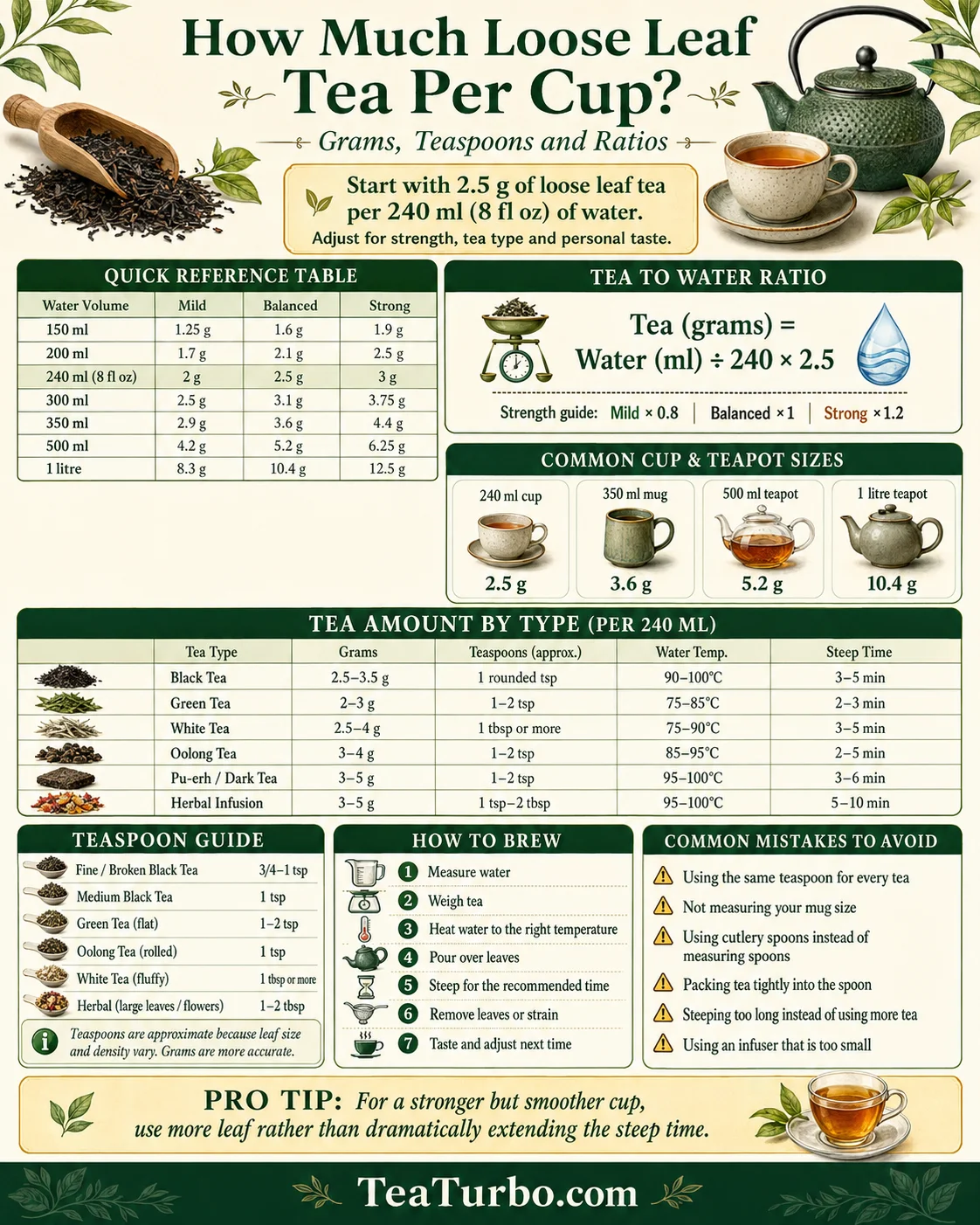
Printable loose leaf tea ratio chart
Use this compact chart as a kitchen reference:
LOOSE LEAF TEA QUICK GUIDE

150 ml water: 1.5–2 g tea
200 ml water: 2–2.5 g tea
240 ml water: 2–3 g tea
300 ml water: 2.5–3.75 g tea
350 ml water: 3–4.5 g tea
500 ml water: 4–6.25 g tea
750 ml water: 6–9.5 g tea
1 litre water: 8–12.5 g tea

Balanced default:
2.5 g tea per 240 ml water

Formula:
Water in ml ÷ 240 × 2.5
Download: Add a downloadable PDF titled Loose Leaf Tea Ratios, Temperatures and Steeping Times.
The printable can also include a QR code linking to the TeaTurbo Tea Brewing Calculator.
Frequently asked questions
Is one teaspoon of loose leaf tea enough for one cup?
One rounded measuring teaspoon is enough for many medium-density teas brewed in approximately 240 millilitres of water. Large, fluffy teas may require two teaspoons or a tablespoon to reach the same weight.
How many grams of tea are in one teaspoon?
There is no universal answer because leaf density varies. One rounded teaspoon of a typical medium-density tea may weigh approximately 2–3 grams, but fine tea can weigh more and fluffy tea can weigh less.
How much loose leaf tea should I use for a mug?
Measure the mug first.
For a common 350-millilitre mug, use approximately 3.5–3.7 grams for a balanced cup.
Should I use more tea or steep it longer?
Use slightly more tea when you want greater strength without excessive bitterness. Extending the steeping time can extract more bitter and astringent compounds, especially from black and green teas.
How much loose leaf tea should I use per litre?
Use approximately:
- 8 grams for mild tea
- 10–11 grams for balanced tea
- 12–13 grams for strong tea
Can I reuse loose leaf tea?
Many whole-leaf green, white, oolong and pu-erh teas can be infused more than once. Increase the steeping time slightly with each subsequent infusion.
Does stronger tea always contain more caffeine?
Not necessarily. Tea quantity can influence caffeine extraction, but caffeine also varies with the tea material, serving size, water temperature, steeping time and preparation method.
A flavour-strength calculator should not be treated as an exact caffeine calculator.
Safety and limitations
Use care when handling boiling water, hot kettles, teapots and glass vessels. Do not overfill an infuser or cup, and ensure that the brewing vessel is suitable for the selected water temperature.
This guide estimates a useful flavour ratio; it does not calculate an exact caffeine dose. Caffeine content can vary considerably, and the FDA advises consumers to consider caffeine from all foods and beverages rather than evaluating one drink in isolation.
Check the ingredient list of herbal blends if you have allergies, take medication, are pregnant or need to avoid a particular botanical. Follow the product label and consult an appropriate healthcare professional when individual medical guidance is required.
Final recommendation
For most cups, begin with:
2.5 grams or approximately one rounded teaspoon of loose leaf tea per 240 millilitres or 8 fluid ounces of water.
Measure the water, weigh the dry leaves and follow the correct temperature and steeping time for the tea type.
Once you have brewed the tea, adjust the leaf quantity in small increments. The best tea-to-water ratio is the one that consistently produces the flavour, body and strength you enjoy.
Sources
- NIST measurement conversions for cups, teaspoons and millilitres.
- UK Tea & Infusions Association guidance recommending one rounded teaspoon of loose tea per cup.
- TeaSource guidance recommending approximately 3 grams per 8 ounces and explaining differences between dense and fluffy tea.
- Teatulia measurement guidance using approximately 2 grams per 8-ounce serving.
- TeaSource brewing temperature and tea-type preparation guidance.
- ITO EN green-tea brewing guidance.
- FDA consumer guidance concerning caffeine intake.
