
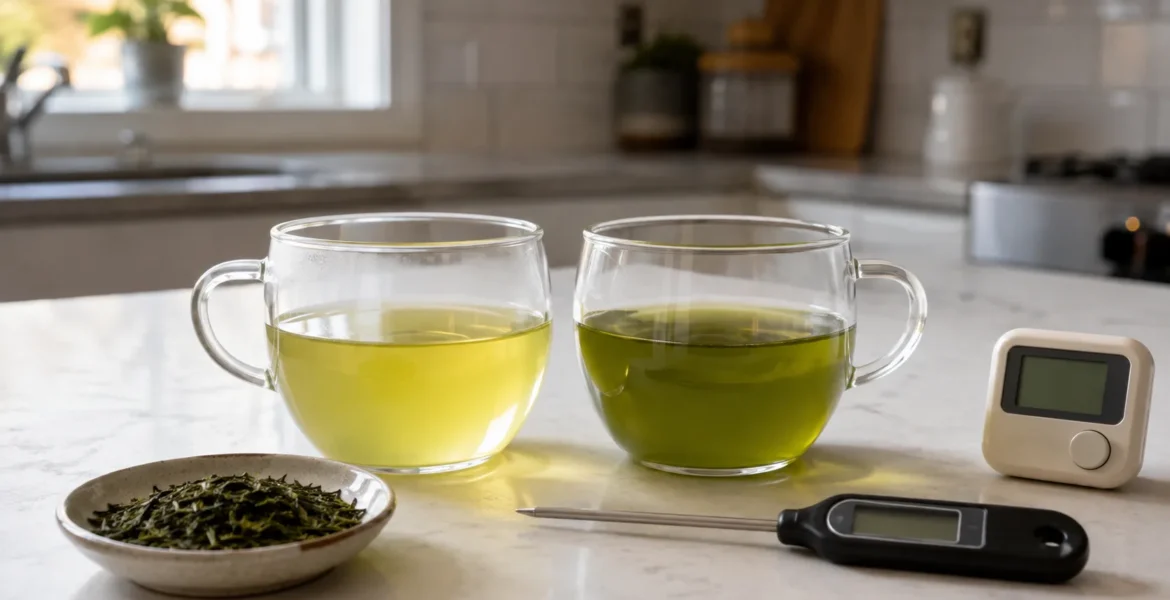
Green tea usually tastes unpleasantly bitter because the brew is extracting too aggressively for that particular tea. Water that is too hot, excessive steeping time, and too much leaf are the most common causes. As a starting point, try about 175°F (80°C), 2–2.5 g of tea per 8 fl oz (240 ml) of water, and a 2-minute steep, then adjust one variable at a time.
That is a starting recipe, not a universal rule. Delicate Japanese teas may work better at lower temperatures, while some roasted or more robust green teas tolerate hotter water. Tea style and manufacturer instructions matter.
| What You Notice | Most Likely Cause | First Change to Try |
|---|---|---|
| Sharp bitterness immediately | Water too hot | Lower temperature by 10–15°F |
| Starts pleasant but becomes harsh | Steep too long | Shorten steep by 30–60 seconds |
| Strong, dense and bitter | Too much tea | Reduce leaf quantity |
| Tea bag turns bitter very quickly | Fine leaf particles | Start with a shorter steep |
| Same tea tastes worse at home | Brewing water | Compare with filtered water |
| Correct brewing still tastes sharp | Natural tea character | Try a different green tea style |
| Recipe works for one green but not another | One-size-fits-all brewing | Follow tea-specific directions |
Why Green Tea Can Taste Bitter
Green tea comes from Camellia sinensis and naturally contains compounds that contribute several different tastes.
Catechins are important contributors to green tea’s bitterness and astringency, while caffeine can also contribute bitterness. Amino acids such as theanine are associated more with savory, umami characteristics.
Brewing changes how much of these compounds enters your cup.
Higher temperatures generally increase the extraction of catechins and caffeine. Research on Longjing green tea found that brewing at lower temperatures around 70–80°C produced a sensory profile with less bitterness and astringency than hotter brewing conditions.
That does not mean hot water literally burns the tea leaves. The more useful explanation is that temperature changes the rate and balance of extraction.
Bitterness and astringency are not exactly the same
These sensations are often confused.
Bitterness is a taste, similar to the bitter sensation you might notice in unsweetened cocoa or grapefruit peel.
Astringency is mainly a mouthfeel. Your mouth may feel dry, rough, puckered, or slightly grippy after you swallow.
Green tea catechins can contribute to both sensations, so an over-extracted cup may taste bitter and leave your mouth dry.
1. Your Water Is Too Hot
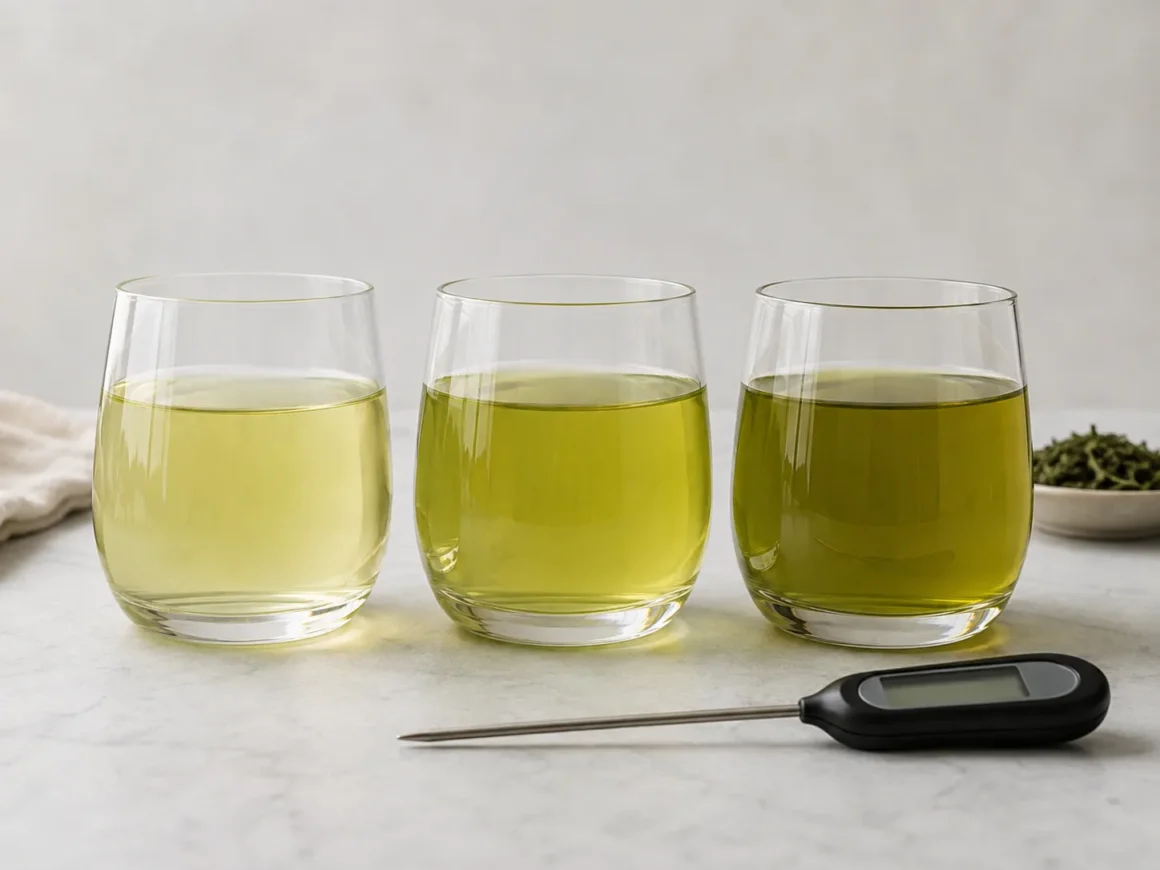
For many everyday green teas, pouring freshly boiling 212°F (100°C) water directly over the leaves produces a much stronger extraction than most beginners expect.
Higher brewing temperatures can increase the extraction of catechins and caffeine, making bitter and astringent characteristics more noticeable.
How to recognize it
Temperature is a strong suspect when:
- the tea becomes harsh almost immediately
- you are using water straight from a boiling kettle
- reducing the steeping time helps but does not solve the problem
How to fix it
For an unfamiliar green tea, start around:
170–180°F (77–82°C)
A useful middle point is:
175°F (80°C)
Then adjust according to the tea.
Some delicate Japanese green teas are commonly brewed much cooler. The Global Japanese Tea Association, for example, describes warm brewing at 140–156°F (60–70°C) for higher-grade teas such as gyokuro and some sencha.
Follow the producer’s instructions when available.
2. You Steeped the Tea Too Long
Time and temperature work together.
Even if your water temperature is reasonable, leaving the leaves in contact with the water for too long allows extraction to continue.
Studies of green-tea brewing have found substantial changes in chemical extraction and sensory properties as brewing time and temperature increase. Extremely long hot infusions can become noticeably less pleasant and more bitter.
How to recognize it
Suspect excessive steeping when:
- the first sip was fine but the cup became harsher
- you leave a tea bag in your mug while drinking
- you regularly steep green tea for 4–5 minutes or longer
- reducing brewing time makes the tea smoother
How to fix it
For a typical Western-style cup, try:
2 minutes
If it is still bitter, try:
90 seconds
If it tastes weak instead, increase the time in small steps rather than jumping straight to several additional minutes.
Use a timer. Thirty seconds can make a noticeable difference with a fast-extracting tea.
3. You Used Too Much Tea for the Water
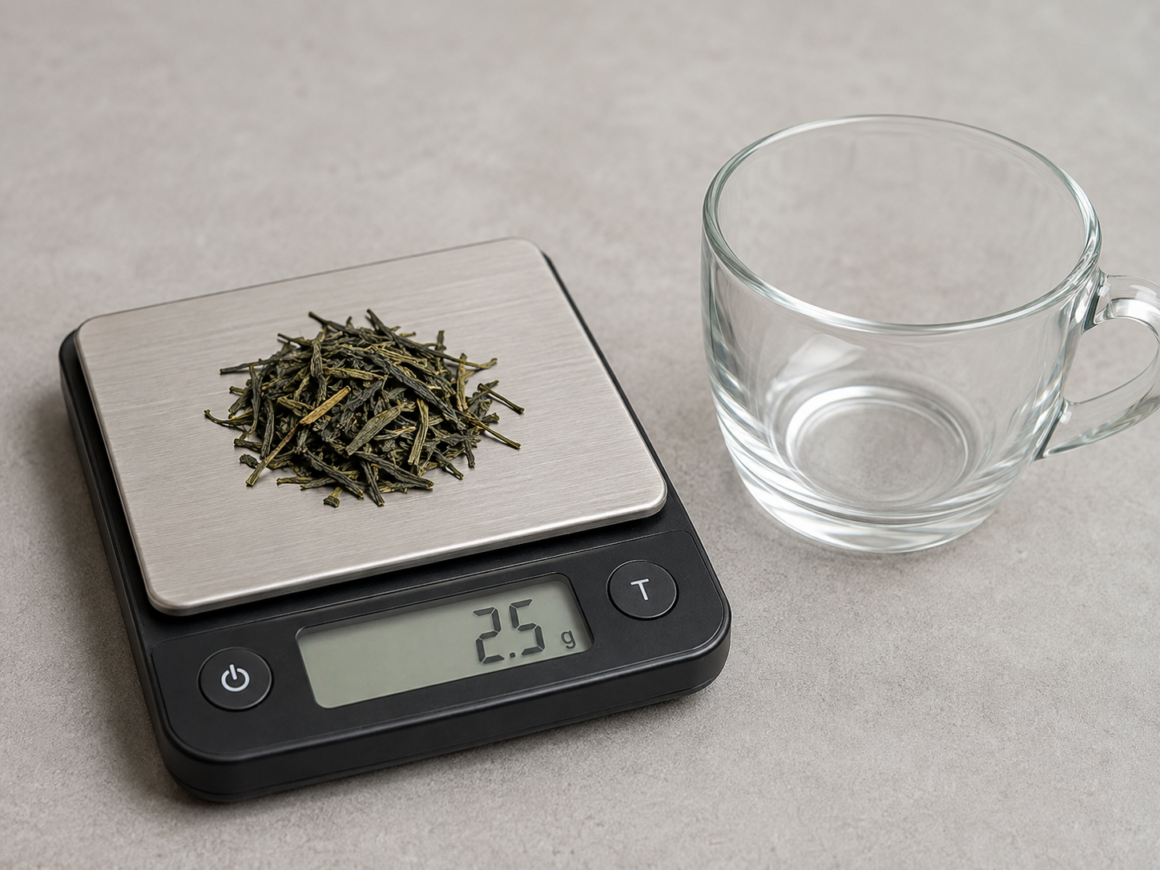
A higher leaf-to-water ratio produces a more concentrated infusion.
TeaTurbo’s existing loose-leaf guide recommends approximately 2.5 g per 8 fl oz (240 ml) as a practical general starting point, with adjustments according to tea style and preference.
How to recognize it
Too much leaf may be the problem when the tea tastes:
- dense
- unusually strong
- bitter even after shortening the steep
- much stronger than the same tea from a café or tea shop
How to fix it
Start with:
2–2.5 g of loose-leaf green tea per 8 fl oz (240 ml) of water
A kitchen scale is more reliable than a teaspoon because green tea leaves vary greatly in size and shape.
If you do not have a scale, use the package recommendation as your first reference.
4. Your Tea Contains Very Fine or Broken Leaves
A tea bag is not automatically low quality, but particle size affects extraction.
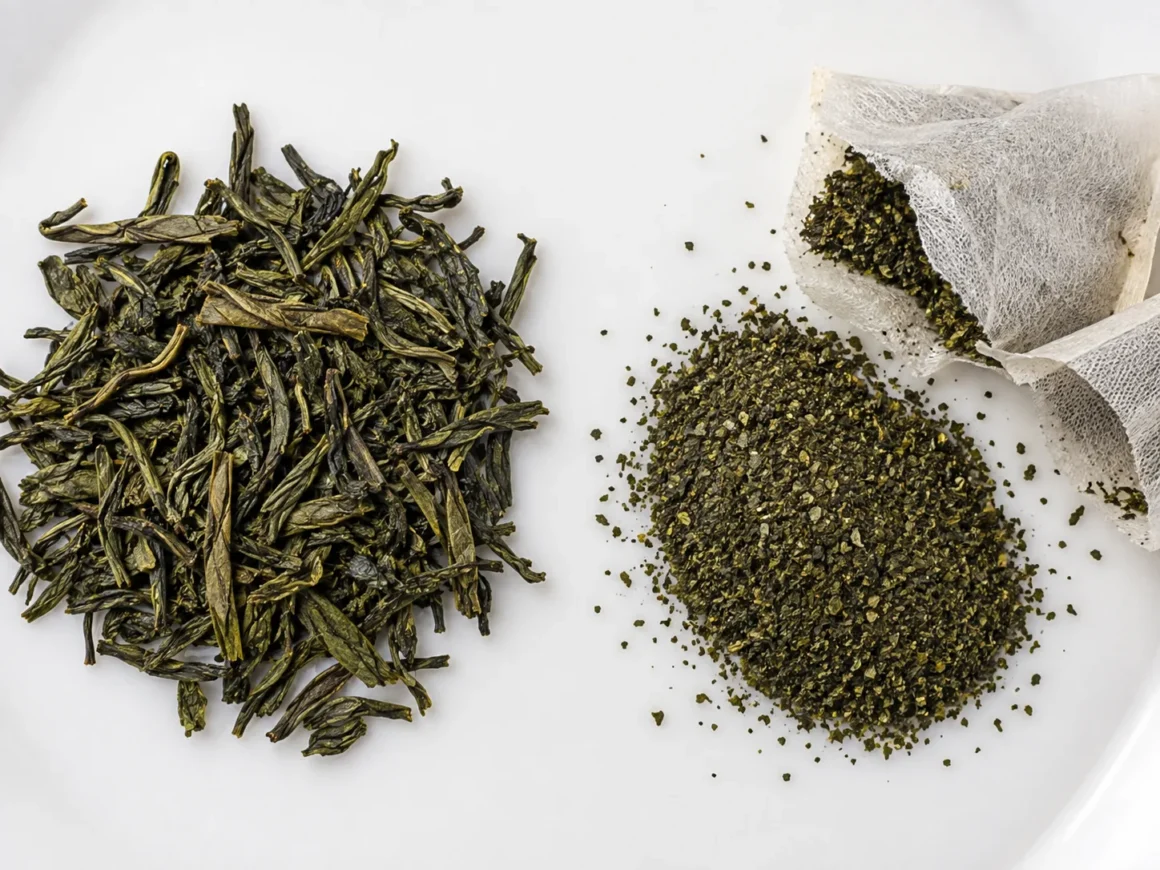
Smaller particles provide more exposed surface area, and research into green-tea catechin extraction shows that particle size can materially affect extraction yield.
This helps explain why a fine-particle green tea bag may become strong much faster than large whole leaves.
How to recognize it
Check the tea after brewing.
If the bag contains powder-like material or tiny broken pieces and the drink becomes bitter within a short time, rapid extraction may be contributing.
How to fix it
For fast-extracting bagged green tea:
- use approximately 170–175°F (77–80°C) water
- taste it after 60–90 seconds
- remove the bag completely once the flavor is strong enough
Do not assume every green tea needs the same 2–3 minute steep.
5. Your Brewing Water Is Changing the Flavor
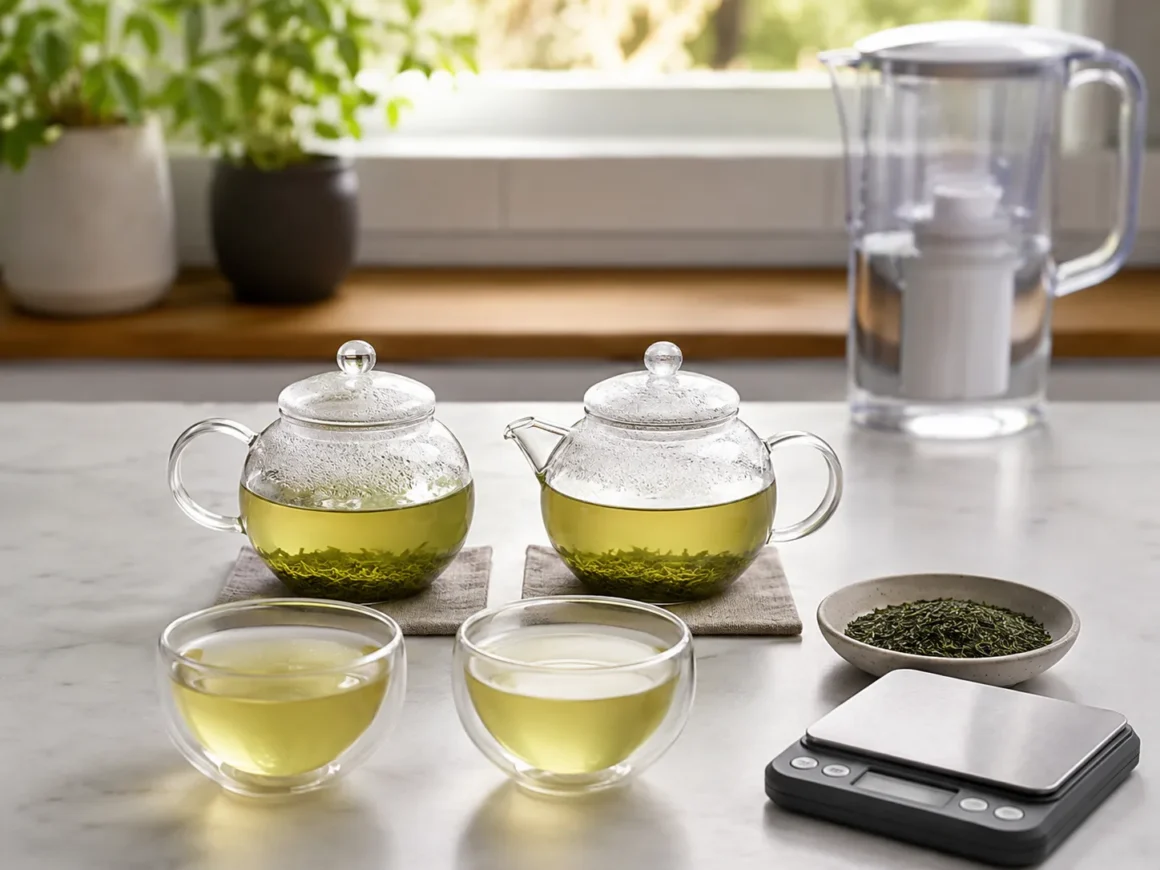
Your water can change what you perceive in the cup.
Research has found that mineral composition and other characteristics of brewing water affect the chemical and sensory properties of green-tea infusions. Different water types can produce meaningful differences in bitterness, astringency, sweetness, color, and aroma.
The Global Japanese Tea Association recommends relatively soft water for Japanese green tea.
How to recognize it
Water is worth testing when:
- the tea tastes good somewhere else but unpleasant at home
- your tap water has an obvious mineral, metallic, or chlorine-like taste
- changing temperature and steeping time does not solve the issue
How to fix it
Perform a simple comparison.
Brew the same tea twice with the same:
- leaf quantity
- water temperature
- steep time
Use your normal water for one cup and filtered water for the other.
Taste them side by side.
Do not automatically assume expensive mineral water is better. Mineral composition matters more than branding.
6. The Green Tea Naturally Has More Bitterness
Not every trace of bitterness is a brewing error.
Green teas vary according to cultivar, growing conditions, harvest, shading, leaf maturity, and processing. Those factors change the balance of amino acids, caffeine, polyphenols, and other compounds that shape flavor.
Research comparing green teas has found meaningful differences in bitterness, astringency, sweetness, freshness, and umami between teas with different chemical profiles.
A little pleasant bitterness can therefore be part of a tea’s intended character.
How to recognize it
Natural leaf character may be the main factor if you have already tried:
- cooler water
- shorter steeping
- less leaf
- different water
and the tea still has a distinct bitter edge.
How to fix it
You can first try brewing cooler.
If you simply dislike the tea’s flavor profile, try another style rather than forcing yourself to enjoy it.
For example, an umami-forward shaded Japanese tea may taste very different from a brisk gunpowder green or strongly vegetal sencha.
7. You Are Using One Brewing Rule for Every Green Tea
“Green tea” is a category, not a single standardized product.
Sencha, gyokuro, Longjing, gunpowder, genmaicha, hojicha, jasmine green tea, and other styles can respond very differently to the same brewing method.
The Global Japanese Tea Association even describes both very cool brewing methods for high-grade Japanese greens and brief, high-temperature brewing for more casual styles such as hojicha, genmaicha, and bancha.
That is why rules such as “all green tea must be brewed at exactly 175°F” are too rigid.
How to recognize it
This may be your problem if:
- one green tea tastes excellent using your usual recipe
- another becomes bitter with exactly the same recipe
How to fix it
Use the package instructions first.
If no instructions are provided, use this neutral troubleshooting baseline:
| Variable | Starting Point |
| Tea | 2–2.5 g |
| Water | 8 fl oz / 240 ml |
| Temperature | 175°F / 80°C |
| Time | 2 minutes |
Then change one variable at a time.
If the cup is bitter, lower the temperature or shorten the time.
If it is weak but not bitter, make a small increase in time or leaf quantity.
Recommended Starting Setup for Less-Bitter Green Tea
For an unfamiliar everyday green tea, TeaTurbo recommends testing this baseline:
- Tea: 2–2.5 g loose leaf
- Water: 8 fl oz (240 ml)
- Temperature: 175°F (80°C)
- Steeping time: 2 minutes
- After steeping: strain or remove the tea completely
Taste the tea before adding honey, lemon, milk, or other ingredients. Otherwise, you may hide the problem instead of diagnosing it.
If it is still bitter
On the next brew:
Change the temperature to 165–170°F (74–77°C) while keeping everything else the same.
If that does not solve it, return to your original temperature and test a 90-second steep.
This one-variable method tells you which change actually helped.
How to Fix Green Tea That Is Already Bitter
You cannot reverse extraction after it has happened, but you may be able to make the cup more pleasant.
Try adding a small amount of plain hot water.
Add approximately 1–2 tablespoons at a time, stir, and taste. Dilution lowers the concentration of everything already extracted.
For iced tea, pouring the brew over ice can also dilute and cool it.
Sweeteners can mask bitterness, but they do not correct the underlying brewing problem. Fix the temperature, time, or ratio on the next cup first.
TeaTurbo Troubleshooting Order
When your green tea is bitter, test changes in this order:
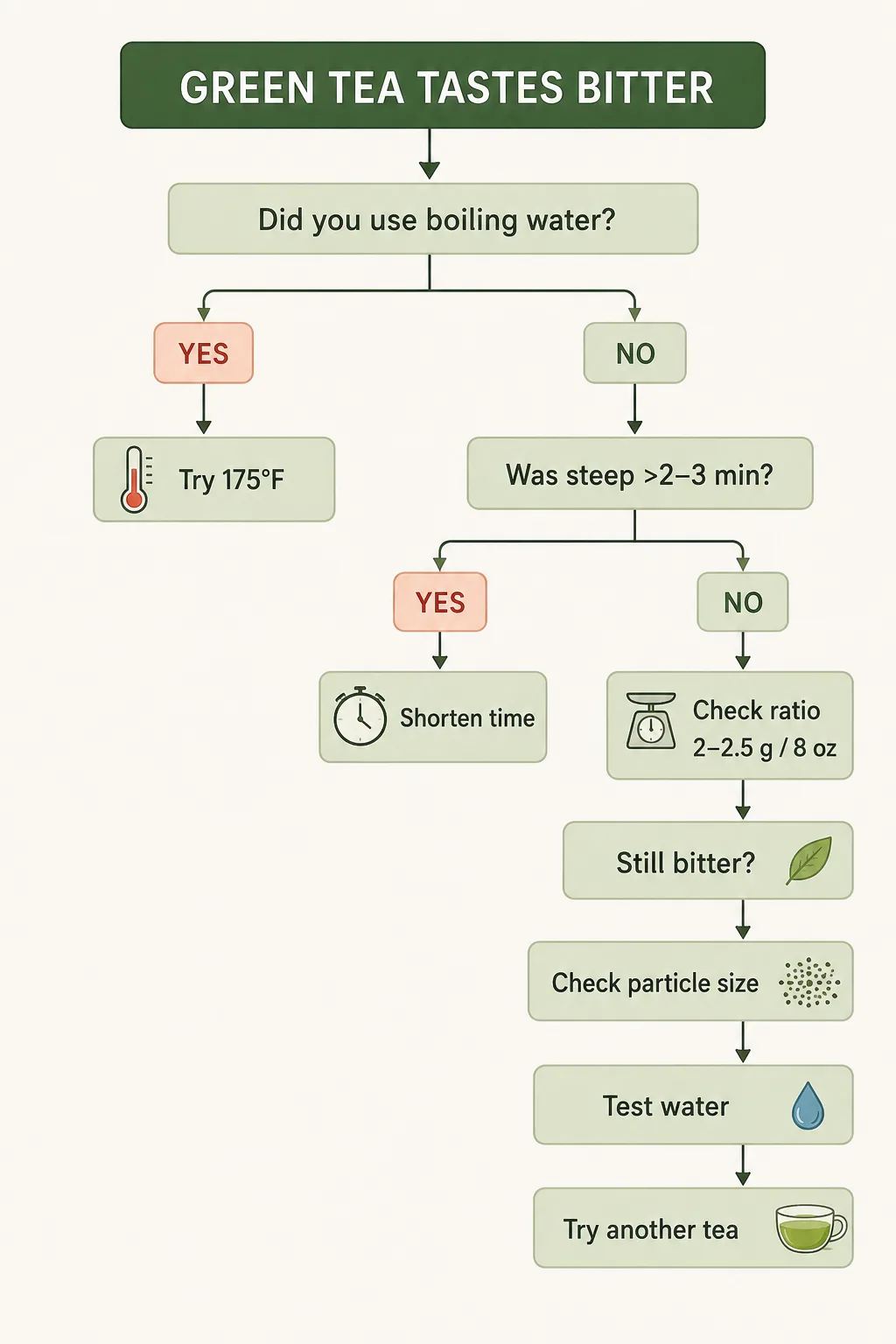
- Check the temperature. If you used boiling water, try about 175°F (80°C).
- Check the steeping time. Start around 2 minutes.
- Measure the leaf quantity. Try 2–2.5 g per 8 fl oz (240 ml).
- Remove the leaves completely. Do not let them continue steeping while you drink.
- Consider particle size. Fine tea bags may need a shorter infusion.
- Compare your water. Test filtered water against your usual water.
- Try another tea style. Some natural bitterness may come from the leaf itself.
This sequence avoids changing four variables at once and never knowing which adjustment actually worked.
A Common Misunderstanding: Is Stale Green Tea Always More Bitter?
Not necessarily.
Poor storage can certainly reduce green tea quality, freshness, aroma, and overall sensory appeal. However, it is too simplistic to say that older tea always becomes more bitter. Research on storage shows that green-tea chemistry changes in complex ways, and some studies have found bitterness decreasing rather than increasing during certain forms of storage.
If your tea smells flat, stale, musty, or lacks fresh aroma, replace it.
But if the main complaint is sharp bitterness, test temperature, steeping time, ratio, and water before blaming age alone.
Mistakes to Avoid
Pouring boiling water over every green tea
Many green teas become more bitter or astringent when brewed hotter, although the ideal temperature depends on style.
Leaving the tea in the mug
Extraction continues while the leaves remain in contact with water.
Remove the infuser or tea bag when the tea reaches the strength you want.
Measuring only by teaspoon
Two teaspoons of different teas can weigh very different amounts.
Use grams when consistency matters.
Changing everything at once
If you simultaneously lower the temperature, halve the leaf quantity, and shorten the steep, you will not know which adjustment fixed the bitterness.
Change one variable per brew.
Assuming bitterness means “more healthy”
A harsher cup simply means you created a different extraction profile. It is not a reliable measure of the beverage’s health value.
Final Takeaway
If your green tea tastes bitter, begin with the three variables that matter most: temperature, time, and tea quantity.
For a typical unfamiliar green tea, try 2–2.5 g of tea in 8 fl oz (240 ml) of water at about 175°F (80°C) for 2 minutes. Remove the leaves completely and taste the tea plain.
If it is still too bitter, change only one thing on the next brew.
Lower the temperature first. Then test a shorter steep. After that, investigate the leaf size, water, and the tea’s natural flavor profile.
The goal is not to remove every trace of bitterness. It is to find the balance where bitterness supports the tea instead of overpowering it.
11. Quick-Answer Table
Recommended for placement directly after the opening paragraph.
| Problem | Likely Cause | First Fix |
| Very bitter immediately | Water too hot | Reduce temperature 10–15°F |
| Gets bitter while sitting | Continued steeping | Remove leaves completely |
| Strong and bitter | Too much tea | Reduce leaf quantity |
| Tea bag becomes harsh quickly | Fine particles | Shorten steep |
| Same tea tastes different at home | Water chemistry | Test filtered water |
| Bitter despite correct brewing | Natural leaf character | Try another style |
| Different greens react differently | Wrong generic recipe | Follow tea-specific directions |
12. TeaTurbo Original-Test Recommendation
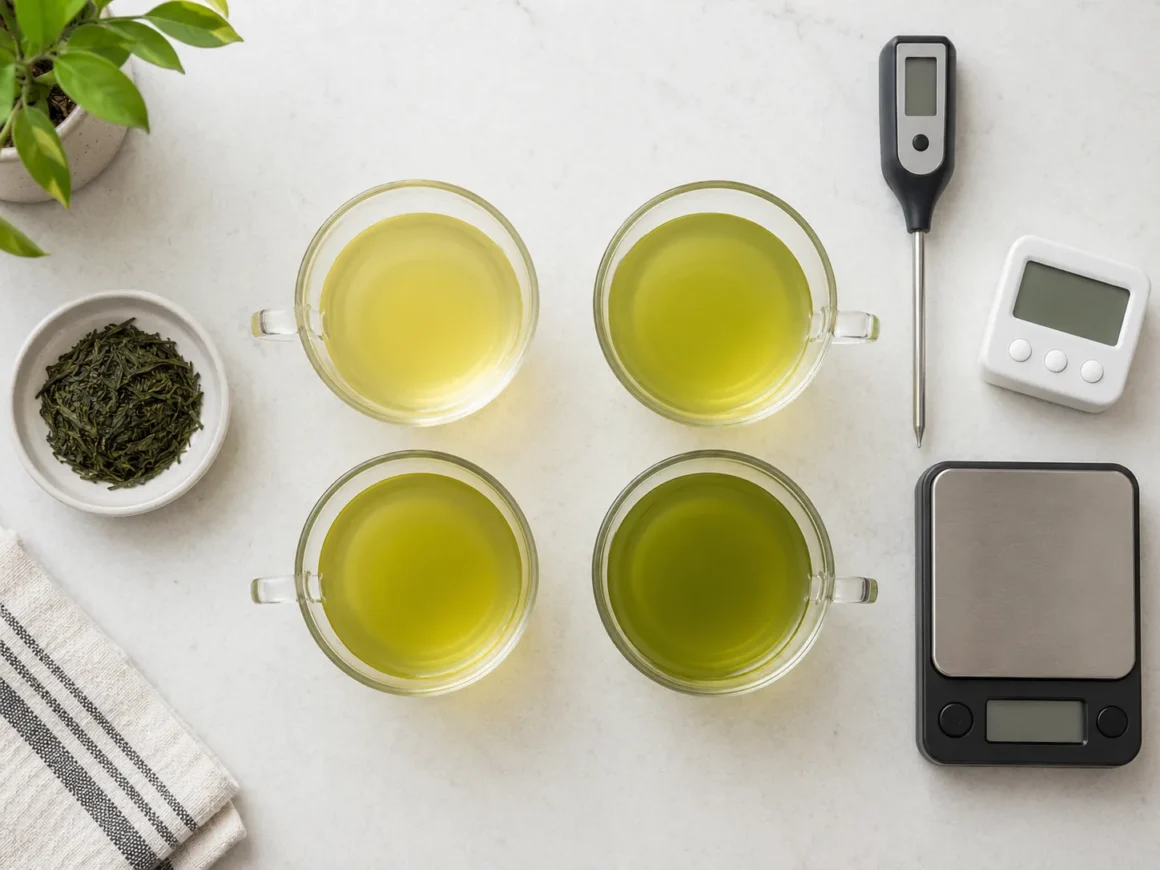
TeaTurbo should perform a controlled brewing comparison rather than claiming first-hand results without testing.
TeaTurbo Test
Tea: One fresh, unflavored loose-leaf sencha or another widely available single-origin green tea
Amount: 2.5 g unless intentionally varied
Water: 8 fl oz / 240 ml filtered water
Baseline Temperature: 175°F / 80°C
Baseline Steeping Time: 2 minutes
| Test | Temperature | Time | Tea Amount | What It Is Designed to Test |
| A | 175°F / 80°C | 2 min | 2.5 g | Baseline |
| B | 195°F / 91°C | 2 min | 2.5 g | Temperature effect |
| C | 175°F / 80°C | 4 min | 2.5 g | Steeping-time effect |
| D | 175°F / 80°C | 2 min | 4 g | Leaf-ratio effect |
For every cup, record:
- bitterness, 1–5
- astringency/dryness, 1–5
- aroma intensity, 1–5
- sweetness/umami perception, 1–5
- overall preference, 1–5
- infusion color
- tasting notes
Do not write final conclusions until the actual test is completed.
Optional second TeaTurbo experiment: water
Use the winning brewing parameters and compare:
- normal household tap water
- filtered tap water
Keep the tea, temperature, ratio, brewing vessel, and time identical.
Photograph the cups side by side and record blind tasting notes if possible.
Read more
- more green tea guides
- beginner’s guide to green tea
- TeaTurbo tea brewing calculator
- tea brewing temperature guide
- how much loose-leaf tea to use per cup
- adjust your tea strength
- why green tea tastes bitter
13. External Authoritative Sources
Xu et al. — Quantitative analyses of bitterness and astringency of catechins from green tea
Peer-reviewed research supporting the role of catechins in green-tea bitterness and astringency.
Deng et al. — Effect of brewing temperature on Longjing tea sensory quality
2025 peer-reviewed research supporting the finding that lower brewing temperatures around 70–80°C can reduce bitterness and astringency while improving the sensory balance of Longjing tea.
Saklar et al. — Effects of brewing conditions on catechin content and sensory acceptance
Peer-reviewed evidence connecting brewing conditions, extraction, and sensory characteristics in green tea.
Global Japanese Tea Association — Japanese Tea Brewing
Professional tea-industry guidance explaining temperature, tea-to-water ratio, steeping time, catechin/caffeine extraction, and the substantial differences between Japanese green-tea brewing styles.
Bai et al. — Effects of brewing water on tea infusion flavor
Peer-reviewed research supporting the role of brewing-water composition in tea chemistry and sensory quality.
Vuong et al. — Optimizing catechin extraction from green tea
Peer-reviewed research supporting the importance of variables including particle size, temperature, pH, and tea-to-water ratio in catechin extraction.
16. FAQ
Why is my green tea bitter even when I use 175°F water?
Temperature is only one variable. Your tea may still be bitter because of excessive steeping time, too much leaf, fine tea particles, brewing water, or the natural characteristics of the tea.
Is green tea naturally bitter?
It can contain some natural bitterness. Catechins and caffeine contribute bitter characteristics, but a well-balanced cup does not need to be aggressively bitter.
What is the best temperature for green tea that tastes bitter?
Start around 170–180°F (77–82°C) for an unfamiliar everyday green tea. If it remains bitter, try a lower temperature. High-grade Japanese teas may be brewed substantially cooler.
Does steeping green tea longer make it stronger?
Yes, longer contact generally changes extraction and can create a stronger infusion, but stronger does not necessarily mean better. Long hot brews may become increasingly bitter or astringent.
Are green tea bags more bitter than loose-leaf tea?
Not automatically. However, many tea bags contain smaller particles that can extract more quickly. Particle size is known to affect extraction, so some bagged green teas benefit from shorter brewing times.
Can I save over-steeped green tea?
You cannot remove compounds that have already been extracted, but you can dilute the cup with additional water. Use a shorter steep on your next brew.
Is bitter green tea healthier?
Bitterness is not a reliable measure of health value. It primarily tells you something about the tea’s composition and the extraction profile of that particular cup.
