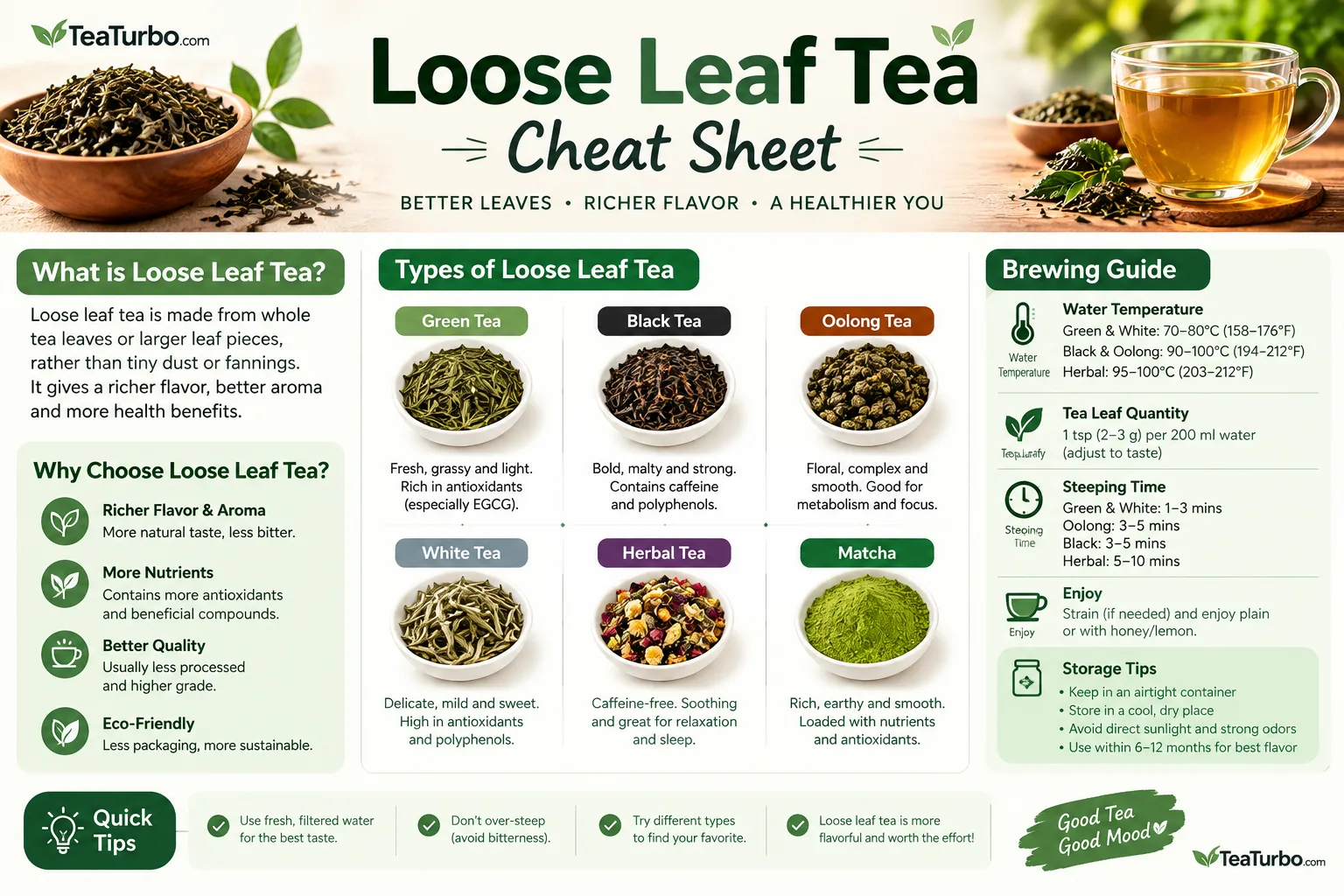
Yes, you can reuse loose leaf tea. Many whole-leaf teas still have flavor and aroma left after the first brew, so a second infusion is often worth making. Green, white, oolong, and pu-erh teas are especially suitable for repeated steeping.
How many times you can reuse the leaves depends on the tea, leaf size, brewing method, temperature, and length of the first steep.
How Many Times Can You Reuse Loose Leaf Tea?
For normal Western-style brewing, use these numbers as practical starting points rather than fixed rules.
| Tea Type | Typical Useful Infusions |
| Green tea | 2–3 |
| Black tea | 1–2 |
| White tea | 2–4 |
| Oolong tea | 3–6+ |
| Pu-erh or dark tea | 3–8+ |
| Herbal blends | Usually 1–2 |
Oolong and pu-erh often last the longest because many of these teas are made from larger, rolled, twisted, or compressed leaves that continue opening as they are brewed.
Short-infusion methods such as gongfu brewing use more tea, less water, and much shorter steeping times. The same leaves can therefore produce considerably more infusions than they usually would in an 8 fl oz (240 ml) mug.
These numbers are not a measure of tea quality by themselves. Stop when the tea no longer tastes enjoyable.
Why Can Tea Leaves Be Steeped More Than Once?
Hot water does not necessarily remove everything from a whole tea leaf during one infusion.
Adding fresh water creates another opportunity for soluble flavor and aroma compounds to move from the leaves into the cup. This is why a second infusion may taste different rather than simply tasting like a weaker version of the first.
Research supports this effect. A peer-reviewed study of 17 loose-leaf green teas found that second infusions still contained substantial amounts of caffeine and several flavanols. Median caffeine concentration in the second infusion was about 83% of the first infusion under the study’s brewing conditions.
A separate 2026 study examining three successive green-tea infusions also found measurable chemical and sensory differences from one infusion to the next.
That does not mean every tea will produce three equally strong cups. It means the first steep does not automatically exhaust the leaves.
Which Loose Leaf Teas Re-Steep Best?
Oolong tea is one of the easiest choices for multiple infusions. Rolled oolongs gradually open in hot water, so their aroma and flavor can develop over several rounds.
Pu-erh and other dark teas can also handle repeated brewing, particularly when prepared using short infusions.
Green tea usually gives a good second steep and sometimes a third. The later cups may taste softer or less bitter than the first.
White tea can often be brewed several times because its large leaves and buds release flavor gradually.
Black tea can be steeped again, but many black teas lose strength faster. A whole-leaf black tea is generally a better candidate for a second infusion than finely broken leaves.
How to Re-Steep Loose Leaf Tea
Reusing the leaves does not require a special technique.
- Drain the first infusion completely. Do not leave the leaves sitting in leftover water.
- Add fresh water. Start with approximately the same amount and temperature you used for the first cup.
- Adjust the time if necessary. With Western-style brewing, adding about 30–60 seconds is a reasonable starting experiment if the second cup is too light.
- Taste before making another adjustment. If the tea is still strong, you may not need a longer steep yet.
Do not automatically use much hotter water for every second infusion. Delicate green and white teas can still become harsh when brewed too hot.
TeaTurbo’s existing loose leaf guide uses about 2–3 grams per 8 fl oz (240 ml) as a general Western-style starting range, although the ideal amount depends on the tea.
Should the Second Steep Always Be Longer?
No.
A slightly longer second steep works well for many Western-style preparations, but it is not a universal rule.
Rolled leaves may be more open during the second infusion than they were during the first. Because water can reach more of the leaf surface, the second brew can sometimes develop quickly.
Use taste rather than automatically adding several minutes.
If your second cup is weak, extend the next infusion gradually. If it becomes bitter or overly astringent, reduce the time or temperature.
Can You Reuse Loose Leaf Tea the Next Day?
Re-steeping during the same tea session is the simplest approach.
Once brewed, the leaves are wet rather than dry shelf-stable tea. There is no single well-established home-storage rule specifically defining how long every type of wet tea leaf can safely sit before another infusion.
For a practical beginner rule:
- Use the leaves again while they are still fresh during the same session.
- Do not leave wet leaves sitting in water between steeps.
- If the leaves have been left damp at room temperature for a long period or overnight, discard them rather than guessing.
- If you choose to save them briefly, drain them well, cover them, refrigerate them promptly, and use them soon.
For everyday tea drinking, saving a few cents’ worth of leaves is rarely worth questionable storage.
Does Re-Steeped Tea Still Have Caffeine?
Yes.
A second steep should not be considered caffeine-free.
Caffeine extraction changes with water temperature, steeping time, tea type, leaf structure, and previous infusions. Research on loose-leaf green tea has found meaningful caffeine remaining in second infusions.
For this reason, briefly steeping tea once and throwing away that water is not a reliable home method for making regular tea decaffeinated.
How Do You Know When the Tea Leaves Are Finished?
The easiest test is your cup.
Stop re-steeping when:
- the wet leaves have very little aroma
- the tea tastes thin or watery
- increasing steep time produces little improvement
- the flavor has become flat rather than simply lighter
- you no longer enjoy the cup
There is no prize for reaching a particular number of infusions.
The useful rule is simple: reuse loose leaf tea while it still produces a cup you enjoy, then replace the leaves.